Postcard Image

Postcard Image
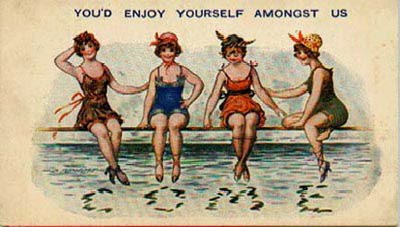
As the Victorian era passed into the Edwardian and Roaring Twenties, a market developed for bisque and china bawdy novelties and figurines of women in revealing outfits. Although now most of these figurines seem more coy and cute than ribald and risque, in their time they symbolized the casting off of the perceived restraints of the Victorian era.

These little lovelies included bathing beauties, who came clad in swimsuits of real lace or in stylish painted beach wear, as well as mermaids, harem ladies, and nudies, who were meant to wear nothing more than an engaging smile. Also produced were flippers, innocent appearing figurines who reveal a bawdy secret when flipped over, and squirters, figurines that were meant to squirt water out of an appropriate orifice.

Most were manufactured in Germany from the late 1800s through the 1930s, often showing remarkable artistry and imagination, with Japan entering the market during World War I.

Showing posts with label Kauba. Show all posts

Friday, February 18, 2022

The Big Reveal

This bronze belle covered in a cloak is another mechanical bronze work by Carl Kauba. 

Of golden bronze, this lovely lady holds out her cloak, patinated dark brown. Her concealing covering is secured by a large bow in the front.

Well, not exactly secured, because the bow is actually a clasp and when it is released, her arms gracefully swing open to reveal her beautifully sculpted nude body.

Kauba's signature appears on the back of the base.

I have always wondered if Kauba cloaked coquette might have been inspired by the American interpretative dancer Loie Fuller, pictured here in a 1893 poster designed by Jules Cheret for the Folies Begere. Born in 1862 as Marie Louise Fuller, she began on stage as a child actress, growing up to become an actress and a dancer. She experimented with flowing silk costumes and multicolored lighting, introducing her "Serpentine Dance" in 1891. Clad in a long dress consisting of multiple yards of thin silk, she held the ends of the skirt in her hands, waving and twisting it as she danced, creating spiraling forms as she exposed and concealed her body, while the changing colored lights suggested everything from flickering flames to ripples of water. In 1892, Fuller joined the numerous American dancers who traveled to Europe for artistic recognition. She settled in France and regularly performed at the Folies. Fuller and her swirling veils became a popular image of the art nouveau movement. She established a dance troupe and continued to experiment with costume and lighting, receiving patents for many of her innovations.


Thursday, October 14, 2021

Basket (Chair) Case

This bashful bronze bathing belle peeks through the drapery of her hooded wicker beach chair. Such chairs were often rented to beach goers by the resort hotel or spa and the deluxe versions came with curtains that could be pulled down for further protection again the sun and wind or for just a bit of privacy.  All that can be seen of this demure damsel is her shyly smiling face and her slender feet clad in dainty bathing slippers.


But atop the dome of the chair's "wicker" hood is a little button. . . . Oooh, what does this button do?

It releases a latch, so that the front swings open, revealing that the lovely lass remembered to bring her bathing slippers, but forget to pack the rest of her swimwear. The 7.5 inch-tall mechanical bronze sculpture is softly patinated in several delicate shades. The curtains are a greenish gold and the drapery framing the top edge of the chair is a pale rose. The bare bather's hair, styled in a wavy chignon, and her bathing slippers, tied at the ankle, have a pinkish-gold patina, while her body is a soft gold. She sits on a reddish cushion with golden trim.


The back base of the chair is stamped "Austria" and incised "C. Thenn gesetzlich geschutzt." "C. Thenn" was one of the names used by the Austrian sculptor Carl Kauba. Born in Vienna in 1865, Kauba studied both at the Academy of Fine Arts in Vienna and in Paris. His bronzes are renown for their intricate and realistic detail and the skilled application of multiple colors of patina. He is best known for his images of the American West (although there is some dispute whether he ever actually traveled to America or was simply inspired by the Wild West fantasies of German author Karl May) and his naughty novelty sculptures which went from innocent to improper by pressing a hidden button or lever. "Gesetzlich geschutzt," means that patent rights have been granted and registered for the design.