Postcard Image

Postcard Image
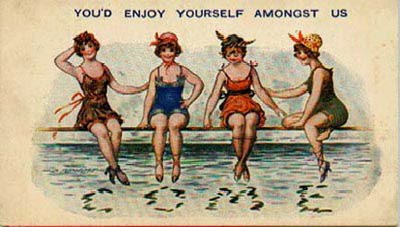
As the Victorian era passed into the Edwardian and Roaring Twenties, a market developed for bisque and china bawdy novelties and figurines of women in revealing outfits. Although now most of these figurines seem more coy and cute than ribald and risque, in their time they symbolized the casting off of the perceived restraints of the Victorian era.

These little lovelies included bathing beauties, who came clad in swimsuits of real lace or in stylish painted beach wear, as well as mermaids, harem ladies, and nudies, who were meant to wear nothing more than an engaging smile. Also produced were flippers, innocent appearing figurines who reveal a bawdy secret when flipped over, and squirters, figurines that were meant to squirt water out of an appropriate orifice.

Most were manufactured in Germany from the late 1800s through the 1930s, often showing remarkable artistry and imagination, with Japan entering the market during World War I.

Showing posts with label plaster. Show all posts

Thursday, April 19, 2018

Packing a Punch

This boxing belle may be related to the sultry sultana featured earlier on this blog.  Of high quality plaster, she shares the same slender modeling, unusual angular face with narrow eyes, and round reddish-brown base.  Wearing her original mohair wig, this pulchritudinous pugilist is 10.5 inches tall and, unfortunately, unmarked.  I wonder if she was originally costumed, and if so, how.  The modeling of her arms against her abdomen would have made dressing difficult, and her stylish high heels would appear out of place in the boxing ring.


However, in the 1927 silent film, "Rough House Rosie," star Clara Bow appeared in boxing garb, complete with pumps. Known as the "It Girl," Bow, with her head full of henna curls and vivacious, carefree persona, personified the young women of the flapper era. The movie was meant as a vehicle for Bow, one of the period's most popular actresses, so it is quite possible that some manufacturer created a pretty plaster prizefighter "inspired" by Bow in her brief boxing attire.  Unfortunately, the film has been lost, with only the trailer and some still photographs remaining. 


A close up of her face shows the meticulous modeling, including parted lips exposing a row of tiny teeth.


Thursday, October 5, 2017

The Mystery Deepens

Earlier in this blog I posted about a mujer de misterio, a señorita from Spain who at first glance appeared to be a fashion figure from Galluba and Hofmann, but in fact was a replica made of plaster.  She now has a sister, also from Spain.  This lovely lass also has a mohair wig, which in this case appears to be original, arms jointed at the shoulders, and molded off-white combination underwear ending just above knees.  Standing on her base, she is 16 inches tall.


She has all the charming characteristics of a Galluba gal, including the perfect oval face, large intaglio eyes, the long slim neck, and surprisingly wide shoulders.  


Her elegant outfit of velvet and lace appears to be all original and is beautifully made.


Underneath are several petticoats trimmed in fine lace and lace knickers with delightful ribbon garters (one could argue this is superfluous as she has molded underwear underneath, but I am glad that her mysterious maker made this extra effort!).  The right or left foot slightly forward is common to Galluba's fashion ladies, but the dainty little feet with multi-strap pumps are not typical footwear for Galluba ladies, who tend to have footwear with elongated toes so that the tips of their shoes are often visible under the hems of their long Edwardian skirts.  Perhaps a little artistic license by her unknown creator?


Her base, trimmed in lavish red velvet and gold braid, is the top of a round box (the bottom is lost to time).  The only mark is “2270/60” in pencil written inside the lid.  One wonders if the box held sweet treats or perfumed power.  Whatever its contents, this must have been some gargantuan  gorgeous gift!  This lady and her lacy outfit are in wonderful condition considering time and the fragility of the materials.  Clearly someone treasured this beautiful box-lid belle for many, many years. 


Spanish craftsmen for centuries have created religious figures and icons out of wood and plaster.  It appears now that sometime in the early 1900s a Spanish artisan decided to branch out into more modern mannequins to adorn shop windows and gift boxes and used the bisque belles of Galluba as a model.  Perhaps someday a catalogue, advertisement, or business card will come to light to help solve the mystery of these lovely ladies of Spain. 

Thursday, May 25, 2017

Plaster, but No Saint

This seductive sultana is of chalkware or plaster.  During the early 1900s, there was a fad for pretty plaster ladies, often dressed in real materials, even if it was just a filmy lace chemise.  Perhaps the best known of these chalkware coquettes are the charming plaster poupees designed by the famed French Boudoir artist Maurice Millier.  I do not know who made this ravishing rani, but she is clad in her original exotic, and somewhat exiguous, outfit.  In surprisingly good shape considering the fragility of her materials, she is 11.5 inches tall and unmarked.  The quality of both the figurine and her costume are quite high for this type of novelty statuette.  Unfortunately, her maker is a mystery.  


She reflects the West's continuing fascination with Orientalism, imaginative and fanciful depictions of a mysterious, seductive, and decadent Middle East.  Her costume appears to have been inspired by the elaborate and lavish costumes created by Léon Bakst for the Ballet Russe's 1910 "Scheherazade." 


In fact, her outfit certainly resembles (sans a couple of thousand dangling pearls) the costume worn by dancer Vera Fokina, who portrayed the unfaithful Zobéide, the favorite wife of Sultan Shahriyar, even to the openings down the front of the legs, the puffy peplum at the hips, and the contrasting bodice.