Postcard Image

Postcard Image
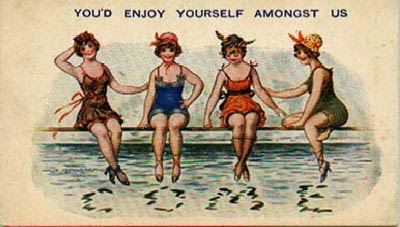
As the Victorian era passed into the Edwardian and Roaring Twenties, a market developed for bisque and china bawdy novelties and figurines of women in revealing outfits. Although now most of these figurines seem more coy and cute than ribald and risque, in their time they symbolized the casting off of the perceived restraints of the Victorian era.

These little lovelies included bathing beauties, who came clad in swimsuits of real lace or in stylish painted beach wear, as well as mermaids, harem ladies, and nudies, who were meant to wear nothing more than an engaging smile. Also produced were flippers, innocent appearing figurines who reveal a bawdy secret when flipped over, and squirters, figurines that were meant to squirt water out of an appropriate orifice.

Most were manufactured in Germany from the late 1800s through the 1930s, often showing remarkable artistry and imagination, with Japan entering the market during World War I.

Friday, August 27, 2021

Picture Perfect


This 1951 Christmas card opens to reveal not your typical holiday theme of snowmen and decorated evergreens. . . 


. . . but a scene of a bearded man in a striped old-fashioned bathing suit photographing three Galluba and Hofmann bathing beauties posing on a rocky shore.


The card is by famed British photographer Angus McBean. Beginning in 1936, almost every year McBean created his own clever holiday cards, using both his skills both as a photographer and theatrical designer to create surrealistic black and white scenes.


Born in South Wales in 1904, McBean grew up fascinated by film and theatre, purchasing his first camera at the age of 15.  He began his theatrical career in 1932, building scenery and props. In 1936, McBean took the production photographs for Ivor Novello’s play, “The Happy Hypocrite.” The photographs caught the eye of society photographer Hugh Cecil, who took McBean on as an assistant.  Eighteen months later, McBean opened his own studio in London. His portraits included many of the talented and famous, from the great stars of the British theater to Agatha Christie, Laurence Olivier, and the Beatles.  McBean died in 1990, on the night of his 86th birthday. 

Another of McBean's works has appeared on this blog, in this 1983 advertisement for Nina Ricci.


However, the inspiration for the ad appears to be the black and white photomontage that appeared in McBean's 1982 Christmas card, which featured a mini-McBean sharing tea with the ladies as a larger McBean lifted the glass dome. The same seated trio of lovely ladies also starred in his 1956 card, which featured McBean, as a dapper Edwardian dandy, joining them for tea on the deck of the S.S Angus.

McBean apparently had quite a collection, as in his 1983 Christmas card, he appears reading a book (perhaps a bedtime story?) to an entire harem of nubile nudes and lace-clad bathing belles.


Saturday, August 14, 2021

Shell Game

Any collector would be a winner with this shell-decorated box topped by two nubile bisque nudes. Although it has become common to refer to any antique shell-adorned box as a "sailor's valentine," the term should properly apply to the intricate and colorful shell creations housed in hinged boxes and produced in Barbados to sell to sailors during the 1800s. However, during the Victorian period it was fashionable for ladies of leisure to engage in shell craft, adorning boxes and other items with tiny shells painstakingly dipped in wax or glue and arranged in elaborate designs. The hobby was so popular that it was possible to purchase patterns and packets of presorted shells. An offshoot of the craze for shell-bedecked knick-knacks was a cottage industry in creating shell-encrusted souvenirs to be peddled at popular tourist resorts along the coasts of England and France. Wood boxes covered in paper, often in whimsical shapes, were decorated with sea shells, typically locally collected. While the sea shells were not as colorful and the patterns not as intricate as those produced in Barbados or Victorian parlors, the boxes were unusual and inexpensive souvenirs of a sea-side sojourn. Often a bisque figurine, a chromolithographed scrap, or other item was included to add color and interest. The two bare bisque bathing belles on this box certainly add both!


Both beauties are each around 4 inches long. It is not possible without detaching them to look for marks, but they appear to be part of a series by William Goebel of lovely ladies clad only in a ribbon tied around their high-piled tresses. 


The box itself is about 8.25 inches long and 4 inches high, not including the sizable shells covering the lid. It is made of thin wood covered in red paper. The interior is lined in faded red fabric and features a mirror edged in red cord. 


Thursday, August 5, 2021

Not So Lucky Cat?

A new post on my maneki-neko page features this rare nodding banko ware cat and discusses why this cute kitty may represent a malevolent supernatural entity.


Saturday, July 31, 2021

Going for the Bronze. . . .

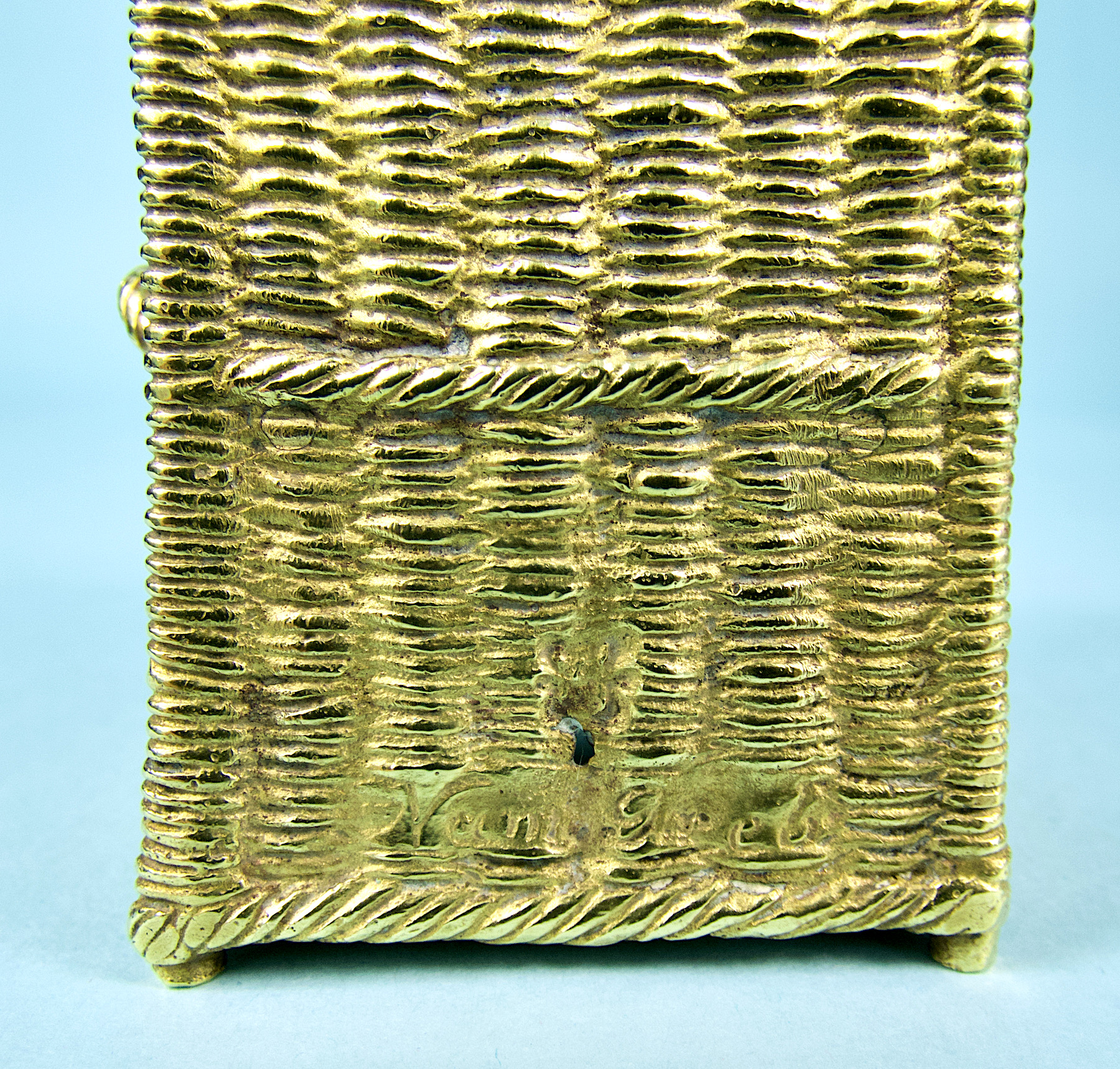
 I had put off posting because I was traveling with a friend to the United Federation of Doll Club's (UFDC) annual convention in Baltimore. Between the UFDC's sales room and the nearby Rowbear's National Doll Festival show, both featuring a bevy of the best doll dealers in the country, I had dreams of adding a number of new and unusual bathing beauties to my collection--perhaps even the ever elusive Galluba and Hofmann beach boy! I went ready to blow my carefully saved wad, but alas returned with my wad relatively intact. Lot of lovely dolls, but few bathing belles and none I did not already have example of in my collection.  So, with the Olympics in full swing, this post is going for the bronze. But the golden gal is certainly is a first place contender! She sits serenely in her wicker beach chair, trying the ribbon to her ballet-style beach slipper (while displaying a well-turned ankle).


Of gilt bronze, the piece is meticulously sculpted, capturing every tiny detail, from the ribbing of her bathing suit to the intricate weave of the wicker. 


The back of the beach chair is stamped with a stylized urn containing a "B" and a cursive signature “Nam Greb.” The urn mark is of the Viennese foundry of Franz Xaver Bergmann, which produced detailed bronze sculptures from the 1860s until 1936. "Nam Greb" is reverse of Bergmann's name (minus one "n"). Some collectors assert that the Nam Greb signature was used on the foundry's more erotic or exotic subjects, but considering that these pieces also often carry the Bergmann cartouche, Bergmann was certainly not trying to hide these works' origin.  This belle in a beach chair is 5 inches  tall.


Thursday, July 1, 2021

We Oughtter Get Into the Water

Won't you come and splash me, splash me,
In the ocean blue?
This is not the place to mash me, mash me,
But we oughtter get into the water!

Then when Percy said, "Oh,
Lou is that the thing to do?" 
She said, "Come along and splash me,
And I'll splash you!"

You Splash Me and I'll Splash You,
Alfred Solman and Arthur J. Lamb, 1907

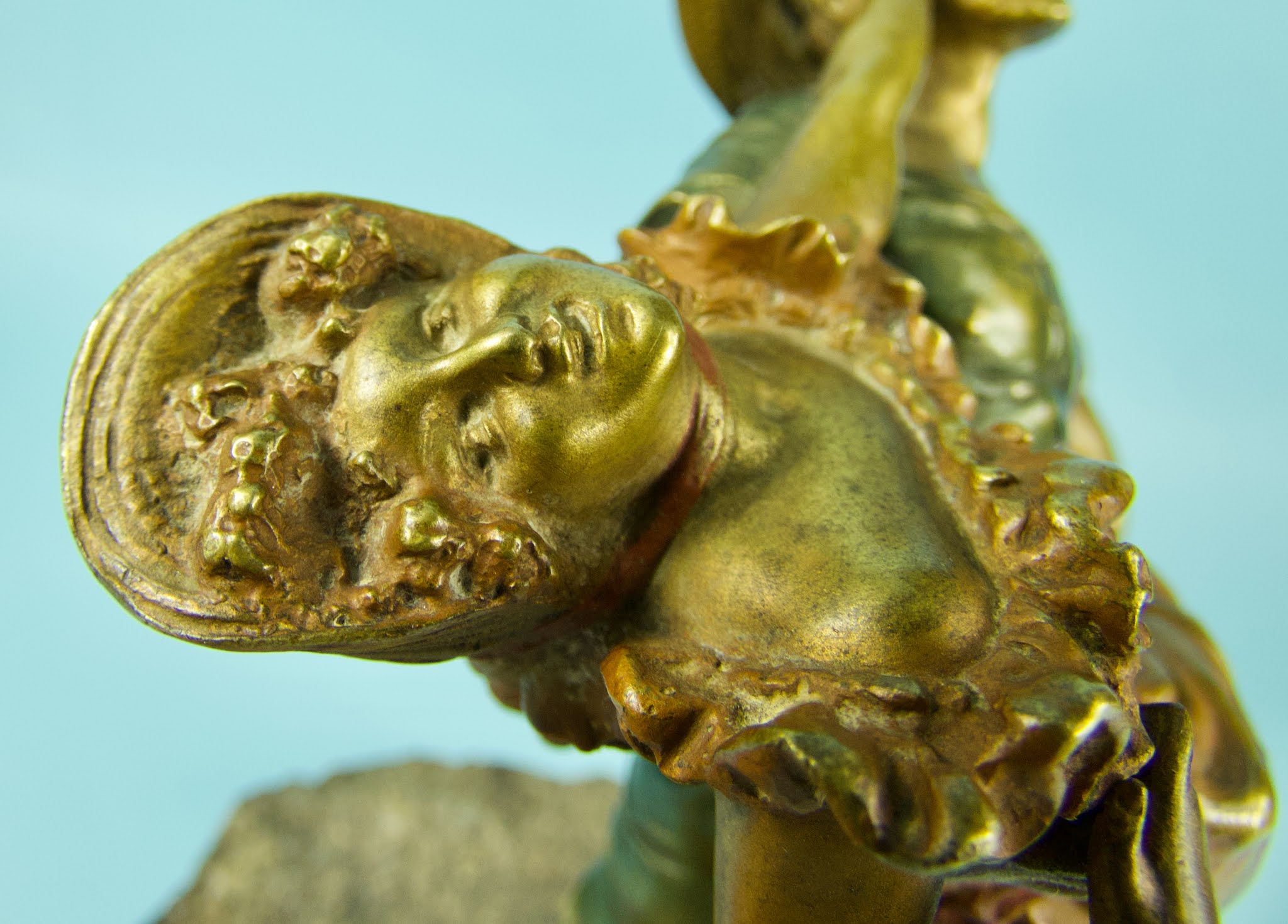
This post features another pair of bronze beachgoers, engaging in a bit of frolicsome seaside shenanigans.  The man is carrying his buxom bathing belle to the edge of the stone on which they stand, no doubt to dunk the damsel in the sea. Although she struggles, their laughing expressions indicate it is all in good fun. Of gilt bronze with translucent cold-painted coloring, this 8-inch tall sculpture is superbly detailed, from the man's straw hat and his lady's tumbling tresses to the folds of their swimwear and the realistic modeling of their anatomy. Stamped on woman's left hip is a "B" in stylized urn, "Gesch," and "4133." The urn mark is of the Viennese foundry of Franz Xaver Bergmann, which produced fine quality bronze sculptures from the 1860s until 1936. "Gesch" is an abbreviation for "gesetzlich geschutzt," which means that patent rights have been granted and registered for the design.  I have seen another example of this scene with the couple cavorting on a bronze pier, which indicates the Bergmann offered this sightly risqué revel on a number of different bases. 


Sunday, June 13, 2021

Come Lie With Me

Come lie with me and be my love
Love lie with me
Lie down with me
Under the cypress tree
In the sweet grasses
Where the wind lieth
Where the wind dieth

Lawrence Ferlinghetti (1919-2021), 1961

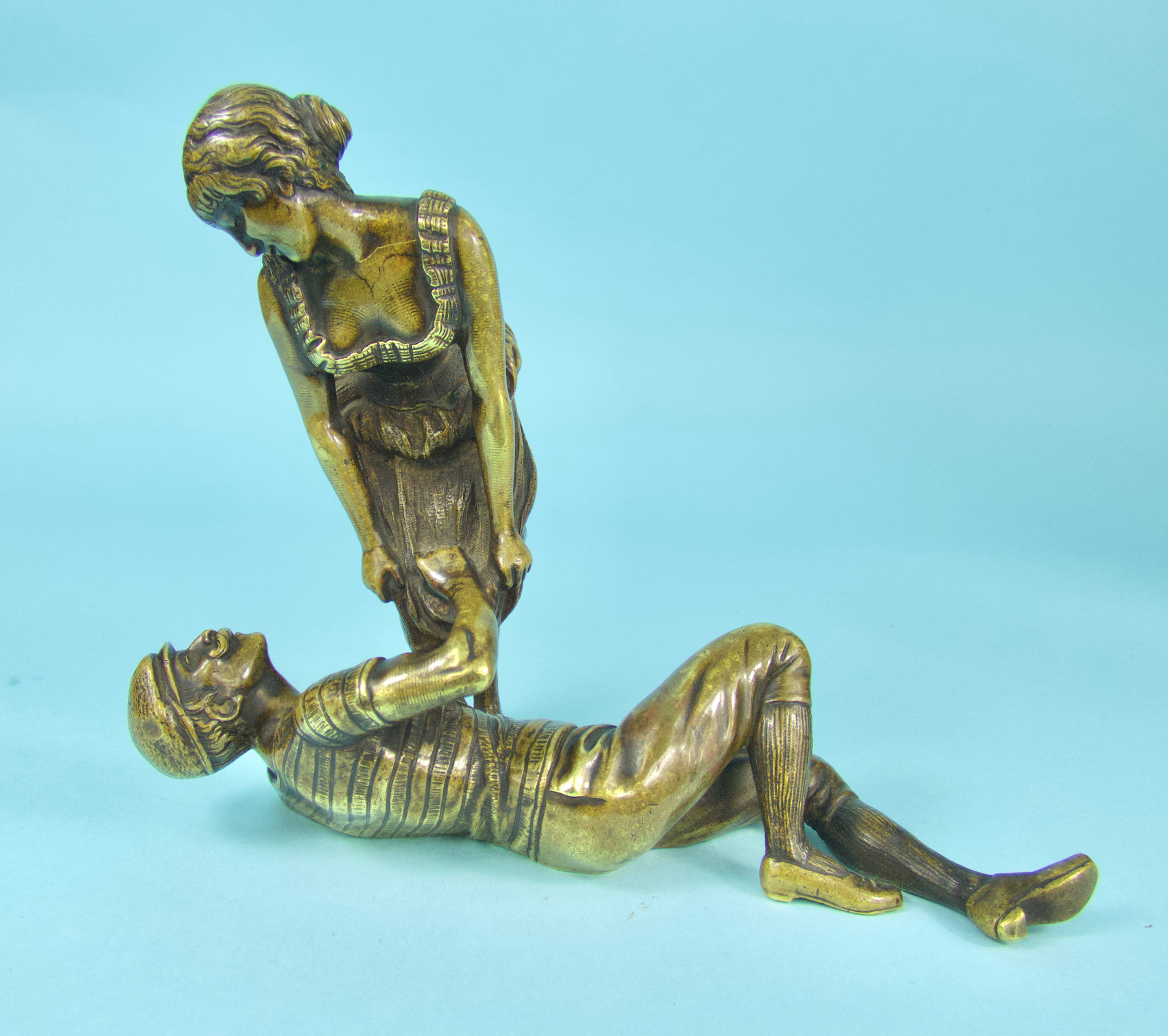
I have gotten a bit behind on my blog, but I think this charming bronze makes up for my neglect. It features two lovers at the seaside, the man, sprawling on the warm sand, gently urging his lovely lady to join him as he tugs at her skirt. She demurs, but her coy reluctance is certainly simply pro forma. How could she possibly resist such a magnificent mustache?!


Of golden bronze, this superbly detailed sculpture is 5 7/8 inches long and 4.25 inches high. 


Underneath man is marked "M," "813" in an oval, and "S." This appears to be the mark of Moritz Spitz, one of the many foundries operating in Austria from the late 1800s through the early 1900s that created fine quality miniature bronze sculptures. 


The slim yet muscular man wears the sort of casual outdoor gear that men of the late Victorian period through the early Edwardian period might don for a seaside stroll, a golf cap, short-sleeved knit striped shirt, knickers, ribbed socks, and walking shoes. His lady's outfit, with the low-cut sleeveless top and skirt raised to expose her lower legs clad in ribbed stockings and low-heeled shoes, is more of a mystery. It is not at all typical of the bathing suits of the era and certainly not something a proper woman would wear out on the street. However, the following photographs provide a clue. They are by  French photographer Léopold-Émile Reutlinger, renown for his portraits of the most famous, and infamous, beauties of the Belle Epoque, from opera singers to performers from the Folies Bergères, as well as artistic erotic pictures, which were reproduced widely on postcards. The pictures are from "Le Panorama," a periodic art publication, and are entitled "Les Saisons, Etè"  (The Seasons, Summer), No. 7. Issued in 1899, the "art" consists wholly of nubile ladies in scanty swimwear carefully posed and photographed by Reutlinger; it appears that many of the portraits were actually taken in a studio and then transposed over seaside scenes. Several of these pictures portray pulchritudinous Parisiennes fishing in the shallows with nets for shrimp and tiny fish. They appear to have removed their outer blouses or jackets and tucked up their skirts around their waists allow them to wade in the low waves. While I doubt many women in reality would dare such extreme public dishabille as pictured by Reutlinger, his imagery certainly is not wholly imaginary and a younger woman, especially on a lonelier stretch of beach, might shuck off a few heavy outer layers of clothing and tuck up her skirt in order to better enjoy the sun and sea. Perhaps that is what this little bronze beauty (undoubtedly with the encouragement of her beau) has done.


Thursday, May 20, 2021

The Lady in Red

Oh! the lady in red, the fellows are crazy 
For the lady in red
She's a bit gaudy, but laudy 
What a personality.

1935, lyrics by Mort Dixon, music by Allie Wrubel

Most collectors, fellows or not, would be crazy for this lady in red in her saucy scarlet swimwear.  Of excellent china and 5 inches tall, she sits insouciantly in a molded wicker beach chair. 


This rubious beauty is actually a utilitarian powder or trinket box. Underneath, her seat is incised "D.F. 216," as well as with the William Goebel intertwined "G" and "W" under crown and "Dep." The Goebel mark is also stamped in blue.


Saturday, May 8, 2021

Bring on the Dancing Girls!

Certainly any collector would want to bring on any dancer as delicate and delightful as this lovely lass.  Of excellent porcelain and beautifully sculpted and decorated, she is 11 inches tall, not including her wooden base.


Although unmarked, she appears in the 1911 catalog of Dressel, Kister, and Company, confirming not only her maker, but that her base is original as well. This must have been a popular pose, as Dressel offered this luscious light of the harem in a variety of sizes and outfits (or no outfit).


Joining the chorus line are two more Dressel dancing damsels. All have their tresses in coiled braids over their ears and while the gorgeous gal in green has donned a turban, the other two wear their hair in a low chignon in the back. The nubile nude is bisque, while the other two are china. 


Another image from the Dressel catalog. 


A back view reveals that these ladies are equally lovely both coming and going. The details and workmanship are exquisite. For example, the center dancer's outfit has been decorated to give the appearance of sheerness and she is stepping out of her slipper as she rises on tiptoe.


This antique cigarette case carries a nearly identical image. Dressel often copied popular paintings and postcards of the day, but so far I have been unable to locate the original image that appears to have inspired both the case and figurines.


Friday, April 23, 2021

In the Cards

These colorful beach belles in their vivid bathing suits are part of an album printed by William S. Kimball and Company, who, in the 1880s, was one of the largest cigarette makers in the world. The invention of machinery to roll and cut cigarettes made cigarettes cheap and plentiful. To expand their market and outcompete their rivals, tobacco companies had to come up with innovative ways to make their products stand out. Originally cigarette packs came with a card or "stiffener" to prevent the cigarettes from being bent or crushed. Beginning in the 1880s, tobacco companies began printing these cards with colorful images. Many of those early images were made to appeal to a largely male clientele, such as sports, military themes, and of course, pretty ladies, such as stage actresses and bathing beauties.


The cards were issued in a series, motivating customers, the tobacco companies hoped, to collect them all (each card included on the back a helpful list of all the other cards in that series). This series entitled "Fancy Bathers," was issued in 1889. There were 50 cards in the series, encouraging a lot of purchasing and puffing in order to procure the full passel of pulchritudinous ladies.

Of course, one needed a place to keep this collection of curvaceous cuties and Kimball obliged by providing a colorful album. These are three pages from the album Kimball issued for its "Fancy Bathers" bevy of cardboard beauties. Each page contains trompe l'oeil images of several of the cards, set against appropriate aquatic backgrounds. As a card was acquired, it could be pasted atop its simulacrum. It is questionable whether such bold and brief bathing attire was ever worn to the beach. I suspect these tobacco cards were the "Sports Illustrated Swimsuit Issue" of their day, featuring scandalous scanty swim attire far more likely to appear in print and the male imagination than at the seaside.


Thursday, April 8, 2021

Pin Up

Her

This swan-diving sea siren is a vintage brass and enamel pin. It closes with an early version of the modern round safety catch, introduced in 1930. This would coincide with the style of her swimwear; the belt and longer legs extending past the top of the thigh are typical of 1930s bathing suits. This brass bathing beauty's sleek curves echo the Streamline Moderne style that emerged from Art Deco design in the 1930s, with its emphasis on clean curving aerodynamic lines that symbolized modernity and progress.


Thursday, March 18, 2021

A Glimpse of Stocking

                                                        In olden days, a glimpse of stocking
Was looked on as something shocking
But now, God knows
Anything goes

Cole Porter, "Anything Goes," 1934

Another member of the toothsome toothpick tootsies troupe, this nubile art nouveau nymph lifts the flap of her flowing robe to expose her bare hip and a glimpse of a rather un-nymphlike black stocking. Of excellent bisque and beautifully modeled, this 5.25 inch tall lissome lass is from the same mystery maker as her sensuous sisters, all attached to a precolored bisque toothpick or match holder of some form (in this case, a tall handled basket). She is marked only with a freehand "16" in black under the basket. Although she resembles some of the black-stockinged belles by the German firm of Schafer and Vater, her beauty is more generic, lacking the unique character of Schafer's laughing ladies, and frankly, the quality and finishing of these toothpick tootsies tends to be better and more consistent than that of Schafer. Although Schafer was perhaps the epitome of creativity and comedy among the German porcelain manufacturers, its quality control was often rather lax.


Thursday, March 4, 2021

Something Fishy

An earlier post on this blog featured flapper bathing belles inspired by the works of illustrator Anne Harriet Fish, which included a Willam Goebel perfume bottle with a pair of pretty bathers. I have since acquired another example of this scarce bottle with its even scarcer top, which is shaped like a black and pink parasol.


Friday, February 19, 2021

On a Pedestal

Certainly any lady this lovely deserves to be on a pedestal. This bisque belle by the German firm of Galluba and Hofmann comes attached to her original stand, which is covered in golden velvet and adorned with real seashells. No doubt she once wore a bathing suit of silk net or lace, now lost to time. I suspect she may have been a high-end souvenir for an exclusive spa or seaside resort. The entire assembly is 7.5 inches high (the lass alone is 6.5 inches).  She wears molded white ballet-style bathing slippers and is marked with a blurred 400 number on the back her base of molded foliage.


The unusual base is of a deep green hard substance (possibly pasteboard), with an incised diamond pattern underneath. I do not know if the base is a creation of Galluba or a jobber who purchased figurines from the company for use in its own designs. 


Monday, February 1, 2021

Friday, January 29, 2021

Undine in Orange

This marvelous mermaid must be part goldfish, as her lower body is clad in deep orange scales. Of excellent bisque, this sinuous sea siren is 4 inches long. By the German firm of Willian Goebel, she is stamped underneath "Bavaria" in black and incised with the William Goebel crown, as well as "NG 16."


Goebel produced these finned femme fatales in a variety of eye-catching colors. Here she poses with the same model, pictured in my second book, who is gorgeous in green. They both have the same marks and the vivid coloring of their scales and tails was applied with an airbrush.


Thursday, January 14, 2021

En-meshed. . .

 . . . which is certainly what any collector would be by this delicate dancer in the remains of her original net costume. She is part of a series by the German firm of Hertwig and Company of sinuous show-girls in exiguous outfits of black mesh. Of excellent bisque, she is 5.5 inches tall and is unmarked. The pedestal behind her is actually a small vase or match holder. 


Thursday, December 31, 2020

Madame Chair

After a detour via bronze, this post returns to the theme of bawdy bisque. This lissome lady appears to have forgotten her gavel, among other things. An unusual seated figure, she is by my favorite maker, A. W. Fr. Kister. As it typical of this company, everything is of the highest quality, from the flawless bisque to the superb sculpting. She is 6.5 inches tall and has her original mohair wig. 

There is a channel through her hips that could be used to attach her to a pincushion. Her current seat is an antique dollhouse chair.  The slightly molded and tinted nipples are a unique characteristic of Kister's beautiful bisque belles. . . 


but her identity is further confirmed, as underneath she is incised with the cross-hatch "S" mark of this company.