Postcard Image

Postcard Image
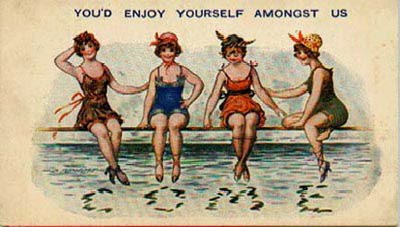
As the Victorian era passed into the Edwardian and Roaring Twenties, a market developed for bisque and china bawdy novelties and figurines of women in revealing outfits. Although now most of these figurines seem more coy and cute than ribald and risque, in their time they symbolized the casting off of the perceived restraints of the Victorian era.

These little lovelies included bathing beauties, who came clad in swimsuits of real lace or in stylish painted beach wear, as well as mermaids, harem ladies, and nudies, who were meant to wear nothing more than an engaging smile. Also produced were flippers, innocent appearing figurines who reveal a bawdy secret when flipped over, and squirters, figurines that were meant to squirt water out of an appropriate orifice.

Most were manufactured in Germany from the late 1800s through the 1930s, often showing remarkable artistry and imagination, with Japan entering the market during World War I.

Showing posts with label Kewpie. Show all posts

Thursday, November 30, 2023

Impudent Imposter

This flirtatious and flamboyant flapper is from chalkware and was probably originally a carnival prize. Unmarked, she is 6.5 inches tall. At first glance, she appears to be a knock-off of Genevieve Pfeffer's Splashme dolls, but there are subtle differences, as the Splashme character has her folded hands tucked under their chin and has molded slippers (this seated bright-eyed bathing belle's bare toes are visible under her painted slippers). 


The position of her hands, the bare feet, and the small molded, but unpainted, wings behind her shoulders instead indicate that the underlying figurine is a direct copy of Rose O'Neill's pensive Kewpie or "The Thinker." The picture below is from my July 2008 article in "Antique Doll Collector" entitled "Genevieve Pfeffer and Her Alluring Girlies," which sets out the history of the Splashme bathing beauty dolls. The photograph contrasts O'Neill's thoughtful Kewp with Pfeffer's flirty girlie. So this round-eyed sea siren is apparently the illegitimate offspring of both the Kewpie and Splashme, with the Kewpie's form and the Splashme's face and ensemble.


Ironically, Pfeffer herself was once accused of copying the pensive Kewpie for her Splashme dolls. The defendants in a 1920 patent infringement suit brought by Pfeffer against Western Doll Manufacturing Company had argued that Pfeffer based her Splashme on the pensive Kewpie. In fact, the 1917 patent is for an "ornamental design for a doll" submitted by Pfeffer shows the original doll with the position of her hands and bare feet matching those of the Kewpie. In that case, the federal district court ruled Pfeffer's patent was invalid, finding that she had merely painted "baby doll" eyes, a flapper bob, and a one-piece bathing suit on a plaster copy of a Kewpie figurine and had not created anything new or novel. However, Pfeffer appealed and in 1922, the United States Seventh Circuit Court of Appeals overruled the lower court and held that Pfeffer's patent was valid. The Splashme's eyes with their star-burst of long lashes, full red lips parted to expose white teeth, bobbed hair, and colorful swimwear would prevent any causal consumer from mistaking the sultry Splashme for O'Neill's innocent imp. 


Thursday, November 21, 2019

Aeroplane Service, Subway Prices

Another old catalog featuring bathing belles, this one from S.K. Novelty Company in Brooklyn, New York.  Its offerings are the type of composition cuties and quasi-Kewpies found on carnival midways, where barkers urged rubes to, "Step right up and win a Kewpie doll for the little lady."


The catalog opens with "Sweetums, the Belle of the Bathers." The price of $11.50 seems extremely extravagant, but it is for a dozen dolls, as made clear on other pages. The catalog states this bather is bisque, but I suspect it is a "bisque finish" advertised on subsequent pages. In the late 1910s into the 1920s, there was a fad for comic googly-eyed bathing beauty figurines. In 1919, Playthings, a magazine for the toy trade, announced that the novelty vogue of the year was wide-eyed "beach dolls" made of wood fiber or composition. The most famous of these flirtatious flapper figures was "Splash Me," copyrighted in 1918 by Genevieve Pfeffer.


Another starry-eyes seaside siren is "Miss Neptune, Jr.," the "Star of the Sea."  She appears to be Sweetums in a different color scheme.  Perhaps her fuller wavy wig is the reason for the dollar difference in the price.


Next is a cadre of composition Kewpie doll knockoffs gaudily gowned in bits of silk, ribbon, and "marabough" (I think the copywriter meant marabou), some with "wonderful" or "beautiful" wigs.  No doubt the material was of the cheapest quality and the costumes simple, but they certainly added to the doll's commercial appeal.


The page featuring "Lovie, Jr." clarifies that the price is for a dozen.  Lovie could be purchased with or without a wig, the bald version being $2 cheaper by the dozen.


The copywriter lays it on pretty thick for "Lotus Flower."  Note that little Lotus is advertised as having a "bisque finish."


Lovie, Jr. reappears, now in a knit bathing suit and cap.  


Another offering in a knit bathing outfit, as well as a mohair wig.


The hand-written margin note states that, "This is absolutely the largest novelty doll in the world."  She is certainly sizable at 18 inches tall and could be ordered with or without a wig.


The final page declares that the company has many other items not listed in the catalog.  It proudly proclaims the company's motto, "Aeroplane service and subway prices."