Postcard Image

Postcard Image
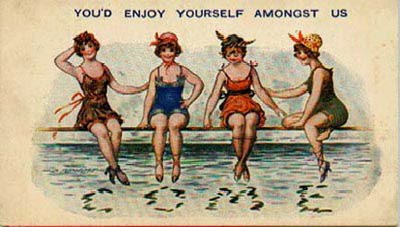
As the Victorian era passed into the Edwardian and Roaring Twenties, a market developed for bisque and china bawdy novelties and figurines of women in revealing outfits. Although now most of these figurines seem more coy and cute than ribald and risque, in their time they symbolized the casting off of the perceived restraints of the Victorian era.

These little lovelies included bathing beauties, who came clad in swimsuits of real lace or in stylish painted beach wear, as well as mermaids, harem ladies, and nudies, who were meant to wear nothing more than an engaging smile. Also produced were flippers, innocent appearing figurines who reveal a bawdy secret when flipped over, and squirters, figurines that were meant to squirt water out of an appropriate orifice.

Most were manufactured in Germany from the late 1800s through the 1930s, often showing remarkable artistry and imagination, with Japan entering the market during World War I.

Showing posts with label marabou. Show all posts

Friday, May 22, 2026

Fluffy Ruffles

 This pretty powderpuff lass is clad only in her ruffled collar and her fluffy marabou feather skirt. She comes in what appears to be the bottom of her original powderbox, as the ribbons around her waist perfectly match the colors of the box. 


She appears to have been captured mid-laugh. Perhaps those swansdown feathers tickle? This half-doll is unusual for the porcelain pom-pom adorning her gold cap and her tinted nipples, the latter an anatomical detail generally absent in the great majority of half dolls and bathing beauties. Her puff is pristine, suggesting that it was never used.


A close up shows the pom-pom, which appears to have been made of string dipped in porcelain; when the piece was fired, the threads would burn away, leaving only the porcelain shell. Her facial painting is also unusual, with amber eyes shaded gray underneath. 


Fluffy Ruffles was in fact the name of an eponymous young comic-strip heroine. Published in 1907 in the "New York Herald," the strip followed attempts by Fluffy Ruffles to obtain gainful employment. Ms. Ruffles was a wealthy young woman of considerable charm and beauty who had lost her inheritance. Left with little more than her wardrobe of fashionable frocks, Ms. Ruffles braves the world of the "working girl" with perseverance and pluck, entering a variety of careers open to young women at the time, such as window dresser, teacher, newspaper columnist, or waitress. Unfortunately, her employment was often impeded by men's unwanted romantic overturns, generally resulting in the loss of her job. Ms. Ruffles became a symbol of the modern independent and resilient young woman; her popularity resulted in a wide variety of merchandise, from paper dolls and candy to frocks and hats, carrying the Fluffy Ruffles name, and even engendered a Broadway musical. By 1908, Ms. Ruffles had been restored to her fortune, using her new wealth to travel the world to do good and help the unfortunate, with the same ingenuity and resolution she had shown in her job hunts. The comic ran until 1909. 

Thursday, November 21, 2019

Aeroplane Service, Subway Prices

Another old catalog featuring bathing belles, this one from S.K. Novelty Company in Brooklyn, New York.  Its offerings are the type of composition cuties and quasi-Kewpies found on carnival midways, where barkers urged rubes to, "Step right up and win a Kewpie doll for the little lady."


The catalog opens with "Sweetums, the Belle of the Bathers." The price of $11.50 seems extremely extravagant, but it is for a dozen dolls, as made clear on other pages. The catalog states this bather is bisque, but I suspect it is a "bisque finish" advertised on subsequent pages. In the late 1910s into the 1920s, there was a fad for comic googly-eyed bathing beauty figurines. In 1919, Playthings, a magazine for the toy trade, announced that the novelty vogue of the year was wide-eyed "beach dolls" made of wood fiber or composition. The most famous of these flirtatious flapper figures was "Splash Me," copyrighted in 1918 by Genevieve Pfeffer.


Another starry-eyes seaside siren is "Miss Neptune, Jr.," the "Star of the Sea."  She appears to be Sweetums in a different color scheme.  Perhaps her fuller wavy wig is the reason for the dollar difference in the price.


Next is a cadre of composition Kewpie doll knockoffs gaudily gowned in bits of silk, ribbon, and "marabough" (I think the copywriter meant marabou), some with "wonderful" or "beautiful" wigs.  No doubt the material was of the cheapest quality and the costumes simple, but they certainly added to the doll's commercial appeal.


The page featuring "Lovie, Jr." clarifies that the price is for a dozen.  Lovie could be purchased with or without a wig, the bald version being $2 cheaper by the dozen.


The copywriter lays it on pretty thick for "Lotus Flower."  Note that little Lotus is advertised as having a "bisque finish."


Lovie, Jr. reappears, now in a knit bathing suit and cap.  


Another offering in a knit bathing outfit, as well as a mohair wig.


The hand-written margin note states that, "This is absolutely the largest novelty doll in the world."  She is certainly sizable at 18 inches tall and could be ordered with or without a wig.


The final page declares that the company has many other items not listed in the catalog.  It proudly proclaims the company's motto, "Aeroplane service and subway prices."