Postcard Image

Postcard Image
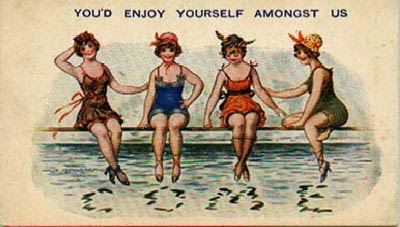
As the Victorian era passed into the Edwardian and Roaring Twenties, a market developed for bisque and china bawdy novelties and figurines of women in revealing outfits. Although now most of these figurines seem more coy and cute than ribald and risque, in their time they symbolized the casting off of the perceived restraints of the Victorian era.

These little lovelies included bathing beauties, who came clad in swimsuits of real lace or in stylish painted beach wear, as well as mermaids, harem ladies, and nudies, who were meant to wear nothing more than an engaging smile. Also produced were flippers, innocent appearing figurines who reveal a bawdy secret when flipped over, and squirters, figurines that were meant to squirt water out of an appropriate orifice.

Most were manufactured in Germany from the late 1800s through the 1930s, often showing remarkable artistry and imagination, with Japan entering the market during World War I.

Thursday, February 26, 2026

Job Benefits

I currently volunteer at the charity consignment shop, Next-to-New. I also write their blog, "Treasures from Our Trove," highlighting a weekly unusual find. Today, after finishing my shift, I was walking through the sales floor, looking for something blog worthy, when I found this delightful picture of a demure bathing beauty.


She is an illustration from French luxury magazine, the "Journal des Dames et des Modes." The Journal, which ran only from 1912 through 1914, was aimed at an educated, urban, sophisticated, fashionable, and wealthy, clientele. The magazine was extremely exclusive and printed in limited quantities. Although its pages included stories, travel articles, and poetry, its focus was on fashion. Instead of being bound, the Journal was issued as a folder containing original hand-colored prints by some of the finest Art Deco artists of the period. Most of these limited edition prints were "pochoirs," created by using a series of stencils for applying each different color. However, this earlier illustration is a hand-tinted etching.

Dated 1912 and entitled "Costume de bain en taffetas changeant," the work is by André Maurice Albert Pécoud, a French artist who worked as an illustrator for many magazines of the period, and was also a renown painter and poster artist. "Taffetas changeant" refers to "shot silk," a silk fabric woven with different colors of warp and weft threads, producing an iridescent fabric. Maybe that is why our lovely bathing belle looks a bit distraught, as she is worried about how salt water might change her "taffetas changeant."


Friday, February 20, 2026

Backward Glance. . . .

The only thing more daring than the décolleté on this bathing beauty's skimpy swimwear. . . .


is the backward glance, revealing that, except for two skinny straps, her entire torso is bare to the waist. Of excellent china and beautifully modeled and decorated, this seaside siren is about 4 inches long and 2.5 inches high. She is incised "19144" on her right hip. The German firm of Carl Schneider used a 14000 to 19000 number series for its half dolls and bathing beauties, and her modeling is similar to this company's products.


The knitted tank suit, first introduced in 1910 by the Portland Knitting Company (later to become the renown Jantzen swimwear), was praised by swimmers and athletes because its form-fitting fabric made movement easier, but it also caused consternation among those concerned with decency and public morals because such suits were. . . form fitting. Still, the tank suit soon became the popular model for swimwear throughout the 1920s, and over that decade the straps became thinner as the legs climbed up the thighs, revealing ever more limb. As this image from a 1936 catalog demonstrates, by the mid-1930s the ever-shrinking tank suit was "business in the front, party in the back." The narrow straps bared the shoulders, making them appear broader, and this, along with belts and contrasting patterns between the top and bottom, gave the illusion of a narrower waist.