Postcard Image

Postcard Image
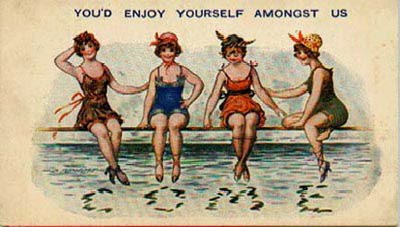
As the Victorian era passed into the Edwardian and Roaring Twenties, a market developed for bisque and china bawdy novelties and figurines of women in revealing outfits. Although now most of these figurines seem more coy and cute than ribald and risque, in their time they symbolized the casting off of the perceived restraints of the Victorian era.

These little lovelies included bathing beauties, who came clad in swimsuits of real lace or in stylish painted beach wear, as well as mermaids, harem ladies, and nudies, who were meant to wear nothing more than an engaging smile. Also produced were flippers, innocent appearing figurines who reveal a bawdy secret when flipped over, and squirters, figurines that were meant to squirt water out of an appropriate orifice.

Most were manufactured in Germany from the late 1800s through the 1930s, often showing remarkable artistry and imagination, with Japan entering the market during World War I.

Showing posts with label Carl Schneider. Show all posts

Friday, February 20, 2026

Backward Glance. . . .

The only thing more daring than the décolleté on this bathing beauty's skimpy swimwear. . . .


is the backward glance, revealing that, except for two skinny straps, her entire torso is bare to the waist. Of excellent china and beautifully modeled and decorated, this seaside siren is about 4 inches long and 2.5 inches high. She is incised "19144" on her right hip. The German firm of Carl Schneider used a 14000 to 19000 number series for its half dolls and bathing beauties, and her modeling is similar to this company's products.


The knitted tank suit, first introduced in 1910 by the Portland Knitting Company (later to become the renown Jantzen swimwear), was praised by swimmers and athletes because its form-fitting fabric made movement easier, but it also caused consternation among those concerned with decency and public morals because such suits were. . . form fitting. Still, the tank suit soon became the popular model for swimwear throughout the 1920s, and over that decade the straps became thinner as the legs climbed up the thighs, revealing ever more limb. As this image from a 1936 catalog demonstrates, by the mid-1930s the ever-shrinking tank suit was "business in the front, party in the back." The narrow straps bared the shoulders, making them appear broader, and this, along with belts and contrasting patterns between the top and bottom, gave the illusion of a narrower waist.


Wednesday, January 29, 2020

Not Throwing in the Towel

This pretty pair of bisque vases feature bathing beauties toying with their beach towels. Both are incised underneath with the Carl Schneider "G" pieced by two vertical arrows and "DEP 12223 Germany." Each vase is 7.45 inches high. They are both superbly modeled out of excellent sharp bisque and beautifully decorated. Some collectors refer to these as "spill vases." A "spill" was a thin wood stick, long wood shaving, or tightly rolled bit of paper; before the availability of inexpensive commercial matches, the spill would be used to transfer a flame from the fireplace, such as to light a candle or pipe. Cylindrical spill vases holding the prepared spills were conveniently placed on the fireplace mantel. During the Victorian era, spill vases became ever more decorative and figurative spill vases often are found in pairs. However, by the time these beach belles were produced, the abundance of inexpensive matches had long made spills, and the vases that held them, unnecessary. But the fashion of matching or complementary figural vases to adorn a mantel or shelf continued.


Friday, June 29, 2018

Let Me Entertain You. . . .

Let me make you smile
Let me do a few tricks
Some old and then some new tricks
I'm very versatile
And if you're real good
I'll make you feel good
I'd want your spirits to climb
So let me entertain you
We'll have a real good time,
Yes sir!
We'll have...
A real good time!

Gypsy, 1959, Jule Styne and Stephen Sondheim


This immodest model by Carl Schneider looks like a showgirl in a burlesque show, languorously lifting away the straps of her elaborate, if exiguous, top.  As Gypsy Rose Lee, the famous American burlesque entertainer and "ecdysiast" who put the tease in striptease, once said, "If a thing is worth doing, it is worth doing slowly…very slowly."


The same model of half doll as pictured in the Schneider catalogue. My lady is 3.25 inches tall and incised "15547." The example in the catalog is denoted as "15545," which could be due to a difference in size or finish. This model came in several sizes and was also offered with a golden brassiere.


Thursday, March 30, 2017

A Stunner by Carl Schneider

For a collector, just when you think you have seen everything, something completely new pops up! At first glance, this big (14.5 inches tall!) beautiful bisque belle appears to be a fashion lady by Galluba and Hofmann. However, her lovely face with its full cheeks and prominent chin is not typical of Galluba and her lower body and legs lack the details often found on a Galluba fashion lady, such as molded ribbed undergarments or high-button shoes.  The base and figure are molded in a single piece, while Galluba ladies were generally molded separately from their bases and subsequently attached with a bit of plaster. 


A closeup of her beautiful face. The mohair wig is original.


However, there is no mystery as to her maker, as she carries the "G" pierced by double arrows of Carl Schneider Erben. In all my years of collecting, I have never before seen such an example.


Although her face, slender arms, and graceful hands are beautifully modeled, below the waist all such delicate details are missing. Unlike Galluba, Schneider was not going to waste time and effort on parts that would be covered by clothing.