Postcard Image

Postcard Image
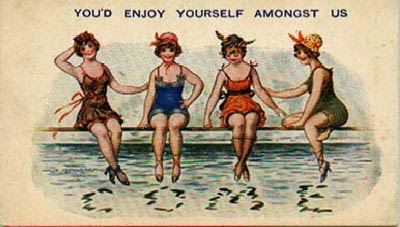
As the Victorian era passed into the Edwardian and Roaring Twenties, a market developed for bisque and china bawdy novelties and figurines of women in revealing outfits. Although now most of these figurines seem more coy and cute than ribald and risque, in their time they symbolized the casting off of the perceived restraints of the Victorian era.

These little lovelies included bathing beauties, who came clad in swimsuits of real lace or in stylish painted beach wear, as well as mermaids, harem ladies, and nudies, who were meant to wear nothing more than an engaging smile. Also produced were flippers, innocent appearing figurines who reveal a bawdy secret when flipped over, and squirters, figurines that were meant to squirt water out of an appropriate orifice.

Most were manufactured in Germany from the late 1800s through the 1930s, often showing remarkable artistry and imagination, with Japan entering the market during World War I.

Friday, May 22, 2026

Fluffy Ruffles

 This pretty powderpuff lass is clad only in her ruffled collar and her fluffy marabou feather skirt. She comes in what appears to be the bottom of her original powderbox, as the ribbons around her waist perfectly match the colors of the box. 


She appears to have been captured mid-laugh. Perhaps those swansdown feathers tickle? This half-doll is unusual for the porcelain pom-pom adorning her gold cap and her tinted nipples, the latter an anatomical detail generally absent in the great majority of half dolls and bathing beauties. Her puff is pristine, suggesting that it was never used.


A close up shows the pom-pom, which appears to have been made of string dipped in porcelain; when the piece was fired, the threads would burn away, leaving only the porcelain shell. Her facial painting is also unusual, with amber eyes shaded gray underneath. 


Fluffy Ruffles was in fact the name of an eponymous young comic-strip heroine. Published in 1907 in the "New York Herald," the strip followed attempts by Fluffy Ruffles to obtain gainful employment. Ms. Ruffles was a wealthy young woman of considerable charm and beauty who had lost her inheritance. Left with little more than her wardrobe of fashionable frocks, Ms. Ruffles braves the world of the "working girl" with perseverance and pluck, entering a variety of careers open to young women at the time, such as window dresser, teacher, newspaper columnist, or waitress. Unfortunately, her employment was often impeded by men's unwanted romantic overturns, generally resulting in the loss of her job. Ms. Ruffles became a symbol of the modern independent and resilient young woman; her popularity resulted in a wide variety of merchandise, from paper dolls and candy to frocks and hats, carrying the Fluffy Ruffles name, and even engendered a Broadway musical. By 1908, Ms. Ruffles had been restored to her fortune, using her new wealth to travel the world to do good and help the unfortunate, with the same ingenuity and resolution she had shown in her job hunts. The comic ran until 1909. 

Friday, May 1, 2026

Ivory Erotica

Following up on my previous post featuring an item of ivory erotica from Japan, I thought I would post this meditative female nude. Also of ivory, she is much more contemporary and, while nicely carved, does not match the quality and skill of the earlier item. Just 2 inches tall, the ivory Schreger lines are clearly visible along her smooth curves. Although she resembles a Japanese netsuke, my suspicion is that she was actually carved in China and created for the European tourist trade like the so-called doctor's dolls. In 1988, I went on a tour sponsored by the American Bar Association of China and Hong Kong and there I saw shop windows crammed with innumerable ivory netsuke and similar carvings, often of a naughty nature. The netsuke were a unique Japanese solution to the problem that Japanese kimonos lacked pockets. Japanese men would carry personal items in punches or boxes suspended on a cord strung through the obi (sash) and the netsuke was strung on one end of the cord to keep the cord from slipping out. When China opened to tourism following President Richard Nixon's visit in 1972, Chinese entrepreneurs quickly learned that Western tourists were a ready market for netsukes, especially erotic ones, and were not too picky about authenticity or even quality, and soon Chinese craftsman began churning out "Japanese" netsukes in ivory, wood, and resin, often with bogus signatures. Some, like this creation, were nicely done, but many were hacked out on lathes and roughly detailed with modern drills. I have in fact seen variations of this same model in ivory, wood, bone, and resin, often far more crudely carved. The demand for ivory resulted in the extensive poaching of African elephants, threatening the wild population. The 1989 Convention of International Trade in Endangered Species (CITES) ban on the ivory choked off, but did not completely end, the contemporary trade in commercial ivory.