Postcard Image

Postcard Image
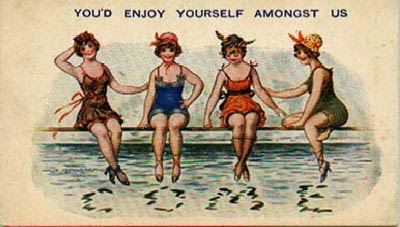
As the Victorian era passed into the Edwardian and Roaring Twenties, a market developed for bisque and china bawdy novelties and figurines of women in revealing outfits. Although now most of these figurines seem more coy and cute than ribald and risque, in their time they symbolized the casting off of the perceived restraints of the Victorian era.

These little lovelies included bathing beauties, who came clad in swimsuits of real lace or in stylish painted beach wear, as well as mermaids, harem ladies, and nudies, who were meant to wear nothing more than an engaging smile. Also produced were flippers, innocent appearing figurines who reveal a bawdy secret when flipped over, and squirters, figurines that were meant to squirt water out of an appropriate orifice.

Most were manufactured in Germany from the late 1800s through the 1930s, often showing remarkable artistry and imagination, with Japan entering the market during World War I.

Thursday, July 2, 2026

In the Black

This blog has featured a number of bronze bathing beauties and naughty novelties from Austria, specifically Vienna, which, beginning in the mid-19th century, became the center for foundries producing finely crafted artistic bronzes to adorn the homes of those wishing to subtly display their taste and wealth. In 1898, Carl Hagenauer opened one such foundry that would later become Werkstätte Hagenauer Wien. His son, Karl, joined the business in 1919 as a designer, influenced by the Vienna Secession, the country's version of the art nouveau movement. His stylized and streamlined designs in bronze and brass were extremely popular, shaping public taste. Just after WWII, Karl introduced a new line of miniature brass pieces that had been oxidized to deep black, then strategically polished so that selected golden highlights shown through. These sleek statuettes with their striking contracts of black and gold were a perfect fit for the mid-century modern design movement, characterized by an emphasis on simplicity and clean, uncluttered silhouettes. The oxidation technique was quickly adopted by other Austrian artists, such as Robert Rohac and Walter Bosse, and soon was copied by manufacturers worldwide. These blackened brass pieces were made in a wide variety of subjects, from whimsical animals to exotic images, such as highly stylized African figures. This lithe lady admiring herself in a mirror is just two inches high and is unmarked.