Postcard Image

Postcard Image
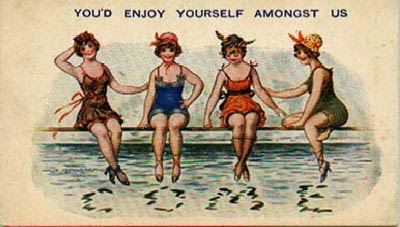
As the Victorian era passed into the Edwardian and Roaring Twenties, a market developed for bisque and china bawdy novelties and figurines of women in revealing outfits. Although now most of these figurines seem more coy and cute than ribald and risque, in their time they symbolized the casting off of the perceived restraints of the Victorian era.

These little lovelies included bathing beauties, who came clad in swimsuits of real lace or in stylish painted beach wear, as well as mermaids, harem ladies, and nudies, who were meant to wear nothing more than an engaging smile. Also produced were flippers, innocent appearing figurines who reveal a bawdy secret when flipped over, and squirters, figurines that were meant to squirt water out of an appropriate orifice.

Most were manufactured in Germany from the late 1800s through the 1930s, often showing remarkable artistry and imagination, with Japan entering the market during World War I.

Thursday, March 20, 2014

Another Gorgeous Galluba Gal


This beautiful bathing belle by Galluba and Hofmann appears in all her original, if slightly tattered, glory.  In addition, at 6 inches long and 2.25 inches high, she is a nice larger size. Her decorator not only endowed her with an especially lovely face, but also dabbed blush on her knees.  Any marks are hidden under the black lace of her bathing suit.


Friday, March 7, 2014

Hidden Gems


This appears to be just an antique man's costume ring, of inexpensive base metal with a gold-tone plating and a cut glass gem.


But peek over the side, and a tiny peephole appears.  And when you peer inside. . . .


a voluptuous belle appears in all her bare beauty  (the picture is actually a full length nude, and very clear, but this is the best photograph I could take through the tiny peephole).  Beneath this ring's false diamond is a hidden gem, an early erotic Stanhope novelty.  John Benjamin Dancer, in 1851, invented a way to produce minute microphotographs that could be viewed only by using a microscope.  In 1857, Rene Dagon improved upon Dancer's invention by placing the microphotograph under a modified Stanhope lens (a Stanhope lens is a simple microscope consisting of a glass cylinder with convex ends).   Stanhope viewers soon became popular with the public.  Tourists could purchase a wide variety of novelties and charms containing souvenir pictures of the sites they had just seen, rosaries and crosses enclosed tiny scrolls bearing the "Lord's Prayer," and portraits of the famous could be found encased in everything from thimble holders to pipes.  And some of those little Stanhope peepholes revealed very private peepshows of nubile nudes or scantily-clad sirens.  I can image a man, sharing brandy and cigars with a few close buddies, slipping off this ring and saying, "Hey, fellas, take a look at this!"

Miniature binoculars were popular holders for Stanhopes.  Usually inside were pictures of popular tourist attractions,  such as various views of Niagara Falls or Parisian landmarks.  This petite pair, just under an inch in height, is carved out of bone.


Inside, they picture a completely different type of attraction, two attractive bathing beauties.  


The actual pictures are much clearer, but again, these are the best photographs I could take through the little lenses.   Along the edge of each picture is the caption "Made in France."
Thursday, February 20, 2014

Kister Sisters


This lovely lithe lady, who is literally having a ball, is by my favorite German manufacturer, A. W. Fr. Kister.  A sizable 7.25 inches long, she wears the remains of her original mohair wig.   Although unmarked. . .  


she is clearly the sister of this pretty miss and her playful pup, who appeared earlier on this blog.  This nubile nude carries the cross-hatched "S" of A.W. Fr. Kister.  She also appears in the Kister catalogue.  


A side by side comparison of this pair of Kister sisters.

Thursday, February 6, 2014

She's My Cup of Tea!

As dainty and delicate as her tiny teacup and saucer, this extraordinarily lovely lady is a fashion figurine from Galluba and Hofmann.   


A close up of her elegant and exquisite face and hands.  She retains her original lush mohair wig.


This marvelous maiden is eight inches tall.  She has long lost her outfit to time, but still sits in her original wooden chair with its velvet upholstery and ormolu decoration.  Although she is unmarked, her chair is stamped underneath with the Galluba mark.


If this bisque belle looks familiar, it may be because I previously posted this 1983 advertisement for Nina Ricci. . . .


which features this trio of terrific Galluba and Hofmann fashion figures.  


Here are my three ladies.  All have long lost their original gowns, but have managed to preserve their mohair wigs.  I wonder what sort of elaborate outfit the literary lady reading the newspaper once wore to match her magnificent millinery!


Here's how they appeared in the Galluba catalogue.  Note the ormolu decorations on the Empire-style furniture.  Galluba clearly lavished as much care in costuming its bisque belles as it did in creating them!


And, thanks to the extraordinary generosity of an English collector, the following are photographs of the famous three from the Ricci advertisement.  Her husband had purchased them from the estate of the fashion photographer who photographed the ad.


Thursday, January 16, 2014

Bookish Beauty

Although a half doll, Ms. 544 is wholly lovely.  By the German firm of Galluba and Hofmann, she retains her original blonde mohair wig.  A molded necklace of raised gold and turquoise dots encircles her long, slender neck and she holds a molded book in her left hand.  Typical of Galluba products, she is of the finest quality bisque and workmanship. She can also be found as a complete fashion figurine. 
 

Thursday, January 2, 2014

A Wanted Man

Recently a friend visited the Toy and Miniature Museum of Kansas City, which is temporarily closing for renovations.  She generously sent me pictures of that male Holy Grail, the Galluba and Hofmann bathing man, which is part of the museum's collection.


I had visited him several years ago, when the United Federation of Doll Clubs had their convention in Kansas City, and left covetous nose prints on his glass case.  I wonder if the museum will let me "babysit" him while the exhibit is closed.  I wouldn't want him to feel lonely and my seraglio of bathing beauties would provide him plenty of company!

Here he appears in the Galluba catalogue, to the far left of the second row.


Every collector has that one piece that he or she feels would help complete a collection.  For me, it would be one of Galluba's bisque beach boys!

Saturday, December 21, 2013

A Very Sweet Bathing Beauty


This bathing beauty bottle was a recent find at an estate sale.  The bottom of the bottle is marked "Des. Patent No. 84181," and tracking this design patent number,  I discovered that the "ornamental design for a bottle" was registered March 12, 1931, by Frank B. Putt and assigned to Brandle and Smith Company, a Philadelphia candy manufacturer.  This clear-glass cutie was intended to be a candy container.  Originally, she would have worn a paper belt as her label and a paper face, held in place by decorative paper confetti or grass, would have been inserted behind her molded glass features.  At 10.5 inches tall, she would have held a lot of sweet treats!


I found this example, said to be all original, including the candy!

Thursday, December 5, 2013

All-Bisque Bathing Beauty Dolls

As I have noted previously on this blog, I collect antique dolls as well as bathing beauties, and I especially like German and French all-bisque dolls.  So this pretty pair of adorable all-bisque dolls wearing their molded bathing suits is a "two-fer" for me!  Big brother is 4.5 inches tall with loop-jointed arms.  He is of excellent bisque and is beautifully decorated.  The tiny hand-painted anchor on his swimsuit adds a jaunty nautical touch.


His slightly smaller sister is 4.25 inches high and she is of the same superb quality.  Neither doll is marked, but they are certainly of the finest German workmanship.


Thursday, November 14, 2013

The Butt of the Joke

This masquerading miss is a little late for Halloween, but she has a trick that is a treat.  The German caption below the masked mädchen looking flirtatiously over a bare shoulder reads "Promenaden scherz" (promenade joke).


Turn the dish upside down and you see it is not just her shoulder that is bare!  The fan-shaped pin dish is of good china and is 4.5 inches wide.  Although unmarked, it is certainly of German origin.


Thursday, October 31, 2013

Happy Halloween!

This blog already features one engaging enchantress, but this bosom belle rides her original besom with a wooden handle and bisque bristles. Of excellent sharp bisque, she is 7 inches tall and is beautifully and realistically modeled.
 
 
Her expression is lively, with a little wicked glint in her intaglio eyes and molded teeth visible between her full smiling lips.

 
These delicious damsels in their domino masks examine their cache of candy corn from a successful night of trick or treating (I will leave it to others to make the obligatory "trick" joke).   
 
 
Both these masked maidens are by William Goebel.  The voluptuous brunette is 4.5 inches high and is stamped "Germany" in black, while the lady with the lute is 4 inches tall and, in addition to the black "Germany" stamp, is incised "3739" and "B."  Both retain the remains of their original wigs.  Typical of Goebel, the wigs are a hank of mohair around the figure's bald pate and held in place with tiny pins.  Because the wigs were not sewn to a supporting wig cap, they tend to unravel over time.

Wednesday, October 9, 2013

Beach Boys (Updated 10/10/13)

This beefcake beach boy by Hertwig and Company has appeared before on this blog.  Of good china, he is incised "544" on the back of his hips.  He is making an encore appearance to introduce. . . .


his (slightly) bigger brother.  This brawny blond is of light-weight earthenware that Hertwig advertised as "feinsteingut."  He is 4 inches long, and in addition to the "544" mark, is incised underneath "16."


This picture from the Hertwig catalogue shows two swimsuit-clad men, model numbers 544 and 545.  I have not yet come across Model 545 in either china or earthenware.


REPRODUCTION WARNING!: The Belgium company Mundial at Kerlouve  is currently reproducing this bathing boy (see HR2009-1 and HR2009-3).  However, as is typical of this company's products, the quality is far below that of the antique originals, with the surface artificially stained to give the pieces the look of age (and to help hide the poor workmanship).  No doubt these pieces are already turning up at antiques markets throughout Europe, where they are being sold as old, and they could fool unwary dealers and collectors who have not had the chance to see the authentic antiques.


Wednesday, September 25, 2013

Their Favorite Things--And Mine Too!

A friend tipped me off to a December 17, 2012, article that appeared in Cape May Magazine entitled "Their Favorite Things."  In the article, four bed and breakfast proprietors in the Cape May beach-side resort share their favorite things, including Sandy Miller of Windward House Inn, who describes the large collection of antique bathing beauty figurines that adorn her B&B. Miller and her late husband, Owen, collected the lovely ladies in the 1980s (I visited Cape May a number of years ago, but was unable to view the fabled Windward House collection because the B&B was closed for the season).


Except not all in the collection are ladies!  As seen in this picture headlining the article, the collection includes at least one scarce male of the bathing beauty species, a rare specimen I have dubbed Mr. Tuffolino.  

REPRODUCTION WARNING:  Mundial Company is manufacturing copies of "Tuffy" in a pink, red, or black bathing trunks (look for HR2011-1 through HR2011-3 under "Baigneueses").  The quality is far below that of the antique original (it does not even have Tuffy's most manly mustache!), but the copies could deceive a dealer or collector who has not had the pleasure of meeting the real Mr. Tuffolino in the flesh (or bisque). 


Tuesday, September 10, 2013

The Last of the Brazen Hussies

This post covers my final example of a Schafer and Vater bisque naughty novelty that has been copied in bronze.


This 5.25 inch long flipper is of excellent sharp bisque and has the caption "Monna Vanna" incised across the nubile nude's diaphanous veil.  "Monna Vanna" was a 1902 opera by Maurice Maeterlinck, which takes place in 15th century Italy, where the army of Florence  has laid siege to Pisa.  Monna Vanna, a beautiful and virtuous Pisan noblewoman, agrees to come to the tent of the leader of the besieging forces clad only in a mantle if he will allow food to enter Pisa to feed her starving fellow citizens.  I suspect Maeterlinck envisioned a much more substantial mantle.

 
The flip side of Ms. Vanna.  This piece has been reproduced in Germany and the copies are often sold as antiques.  One version is glazed solid pink or green to imitate the precolored bisque often used by Schafer.  The other version is of good white bisque and colored like the original.  However, in the copy, the colors tend to be deeper and brighter and the painting, especially the facial painting, is carefully, almost stiffly, done, unlike the usual freer and loser hand typical of Schafer decorators.

 
Here is the metal model of Monna.  The folds in her cloak and the flow of her long tresses are almost identical to bisque version, suggesting that some foundry copied the Schafer figurine for this casting.

 
The end of both Ms. Vanna and my series of immodest metal maidens.

Wednesday, August 28, 2013

Brazen Hussies, Part II


This post continues my exploration of bisque belles by Schafer and Vater and their metallic mates.  This beguiling geisha is a bisque flipper by Schafer.  Of excellent sharp bisque, she is 5 inches wide and the caption incised along the hem of her kimono reads "The Yellow Peril."

 
Flip her over and you discover she has neglected to fasten her very Western knickers, her bare bottom framed by her ruffled petticoats and her legs clad in the black ribbed stockings so favored by Schafer.


Here is the same flipper in bronze.  The modeling is nearly identical to the bisque version, down to the folds in the kimono and the caption along the hem.


She is also a near match underneath, even to the ruffles of the undergarments.  This particular flipper has also been found in copper, aluminum, and other metals, but the casting is often of far lower quality, with many of the details blurred or lost.

Again, the question; which came first, the bisque or the bronze?  Because the bisque versions are so characteristically Schafer, and the metal maidens so closely copy their bisque sisters, I suspect that some foundry used the original Schafer pieces as models for its molds.  I wonder whether this was a partnership between Schafer and a foundry, or pure plagiarism. 


Friday, August 16, 2013

On A Roll(s)


Following my August 14, 2013, posting, a friend sent me a link to an article on the BornRich website about one-of-a-kind custom Rolls Royce mascots, which pictured the above "Naughty Lady" hood ornament from David Robson's 1912 Silver Ghost.  She is clearly a copy of Ms. #442, down to the incised design on the dress and the textured base.  I wonder if the artist in fact made the mold directly from a Schafer and Vater piece.  Maybe I should contact Mr. Robson about commissioning one for my car, but I doubt she would present quite the same panache on the hood of a 2001 Toyota Echo. 

Wednesday, August 14, 2013

Brazen Hussy!


Ms. #442 has previously been pictured on this blog.  This lively and limber lady is by Schafer and Vater.


Here is the same model, but in cold-painted bronze instead of bisque.  Other than some small and subtle changes, such as the loss of the incised design on the bisque version's black dress, the bronze belle is identical to her bisque sister.  Unmarked and 4.5 inches tall, this heavy metal miss would have been a pulchritudinous paperweight for a man-around-town's desk.
 
The question is which came first, the bisque or the bronze?  Did Schafer copy the bronze to model its mold, or did some foundry use the Schafer lady for the bronze casting?  There is no evidence I know of that Schafer operated a foundry in addition to its prolific porcelain factory.  Yet, I have two other metal maidens in my collection that are most definitely bronze versions of well-known Schafer pieces.  One will appear in my next post.*
 
*By the way, I have begun to post every other Wednesday, as I have pretty much posted pictures of every item in my collection that is not already included in my second book.  Coming up with a new idea every week is not easy, so I have eased off a bit.  But I promise to post at least twice a month, so please continue to check back!

Wednesday, July 31, 2013

Another China Charmer by Gebruder Heubach


This bobbed-hair bathing beauty is by Gebruder Heubach.  Of excellent china and beautifully modeled, this 5 inch long nude is incised underneath with "11899" and stamped with "Made in Germany" in a circle in green.  The circle mark is identical to another Heubach bare belle pictured earlier on my blog   That lithe lass is incised "11896" (Heubach used a 10000 and 11000 number series for many of its nudes and bathing beauties).  Like her seated sister, this slender siren has her carmel-colored hair molded in a very short, severe style, full well-shaped coral lips, a very pale complexion softly shaded with faint blushing, and a slim adolescent physique.