Postcard Image

Postcard Image
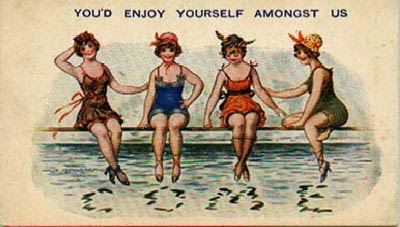
As the Victorian era passed into the Edwardian and Roaring Twenties, a market developed for bisque and china bawdy novelties and figurines of women in revealing outfits. Although now most of these figurines seem more coy and cute than ribald and risque, in their time they symbolized the casting off of the perceived restraints of the Victorian era.

These little lovelies included bathing beauties, who came clad in swimsuits of real lace or in stylish painted beach wear, as well as mermaids, harem ladies, and nudies, who were meant to wear nothing more than an engaging smile. Also produced were flippers, innocent appearing figurines who reveal a bawdy secret when flipped over, and squirters, figurines that were meant to squirt water out of an appropriate orifice.

Most were manufactured in Germany from the late 1800s through the 1930s, often showing remarkable artistry and imagination, with Japan entering the market during World War I.

Showing posts with label bisque. Show all posts

Friday, August 18, 2023

At Last. . . a Man!*

Anyone who has followed this blog knows that I need a man, most specifically a beach beau by Galluba and Hofmann, but considering how rare the male of the bathing beauty species is, I am on the lookout for any handsome seaside studmuffin. This gorgeous guy has recently joined my collection, much to the delight of my bounteous bevy of bisque bathing belles. Of sharp precolored bisque with loop jointed arms, he is 6.5 inches tall. He has a slim, well-toned male body. . . 


including a nice tight tush.


There are holes in the soles of his feet for the supporting rods of a stand. The only mark is "Foreign" stamped in black on the sole of his left foot. In 1890, the United States Congress enacted the McKinley Tariff Act, which included the requirement that items imported to the United States be marked with their country of origin. The use of "Foreign" was initiated as a way to comply with the Act, as well as subsequent laws enacted by other countries. The "Foreign" mark not only indicated that an item was manufactured for export, it could be used to avoid marking the originating country's name on a product when there might be some tension between it and receiving country. For example, goods from Western Germany imported behind the Iron Curtain and some Japanese goods manufactured for import to the United Kingdom through the 1940s might carry the "Foreign" mark. 


In this case, I think this gent can be safely attributed to the German firm of Hertwig and Company, dating from the 1920s through the 30s. On January 7, 2001, Theriault's auctioned off samples from the Hertwig archives, which included this bisque bride and groom. The modeling and facial decoration on the groom is nearly identical to that of my guy.


A similar Hertwig bride and groom from my own collection also establish the strong family resemblance.


I suspect with the jointed arms and the holes in the feet for a supporting stand, my new guy was intended to be dressed (the jointed arms would have made costuming easier) and displayed, most likely as a groom. However, he certainly nicely sets off his new swim attire, created from a scrap from an antique wool bathing suit.


* The title is a line from a 1937 Warner Brothers cartoon entitled "I Only Have Eyes for You." In the cartoon, all the characters are anthropomorphized birds. The homely ice man is wooed by the lonely spinster, but he has a crush on the pretty Katie Canary, who longs to marry a radio crooner. Early in the cartoon, the iceman delivers ice to the spinster, who tries to woo him with all sorts of food. When he hides under her bed, she shouts, "At last. . . a man!" (around 2:09 minutes) and dives in after him (it's a sexist joke that Warner Brothers used over and over through the years).
 

Friday, November 18, 2022

Staying Afloat

This little bathing boy knows just how to keep his head above water. Of fine rosy bisque, beautifully modeled and decorated, and clad only in blue and white striped bathing trunks, this 4-inch long figurine is surprisingly lightweight for its size.


That is because this little beach boy is hollow, so when he is gently placed in water, he does the back float. Called badekinder (bathing children), they were produced in Germany as children’s playthings and bath toys. However, the delicate thin bisque shell could not tolerate too many knocks against the side of a bowl or bathtub, so few of these sweet little swimmers seem to have survived.


Friday, March 18, 2022

Reunited. . .

. . . and it feels so good
Reunited 'cause we understood
There's one perfect fit
And, sugar, this one is it
We both are so excited 'cause we're reunited, hey, hey

"Reunited," Dino Fekaris and Freddie Perren, 1978

The spill vase of the lissome lass preparing to dive next to a giant water lily has been in my collection for many years. However, at a recent serendipitous nearby estate sale, I came across her matching mate, a man in a similar striped bathing suit leaning against an identical oversized lily. From his appreciative smile as he admiringly gazes upon the diving damsel, I think he is happy they are finally back together. These bisque vases are each about 4.75 inches tall and are unmarked, although they are certainly of German origin.


Friday, January 29, 2021

Undine in Orange

This marvelous mermaid must be part goldfish, as her lower body is clad in deep orange scales. Of excellent bisque, this sinuous sea siren is 4 inches long. By the German firm of Willian Goebel, she is stamped underneath "Bavaria" in black and incised with the William Goebel crown, as well as "NG 16."


Goebel produced these finned femme fatales in a variety of eye-catching colors. Here she poses with the same model, pictured in my second book, who is gorgeous in green. They both have the same marks and the vivid coloring of their scales and tails was applied with an airbrush.


Thursday, May 14, 2020

Spring in Her Step

Tell this laughing lass to shake a leg and she will happily comply.  She appears to be peeking over the edge of her spread skirt, which forms a shallow round trinket or ring dish.  Her two lithe legs jut straight up, each attached to the base by a small spring that allows them to quiver and quake.  Although only stamped underneath in black "Made in Germany," she is no doubt from the company of Schafer and Vater, known for its lissome leggy ladies.  Of excellent sharp bisque,  this miss and her  shimmying stems are 3 inches long and high. 


Thursday, November 21, 2019

Aeroplane Service, Subway Prices

Another old catalog featuring bathing belles, this one from S.K. Novelty Company in Brooklyn, New York.  Its offerings are the type of composition cuties and quasi-Kewpies found on carnival midways, where barkers urged rubes to, "Step right up and win a Kewpie doll for the little lady."


The catalog opens with "Sweetums, the Belle of the Bathers." The price of $11.50 seems extremely extravagant, but it is for a dozen dolls, as made clear on other pages. The catalog states this bather is bisque, but I suspect it is a "bisque finish" advertised on subsequent pages. In the late 1910s into the 1920s, there was a fad for comic googly-eyed bathing beauty figurines. In 1919, Playthings, a magazine for the toy trade, announced that the novelty vogue of the year was wide-eyed "beach dolls" made of wood fiber or composition. The most famous of these flirtatious flapper figures was "Splash Me," copyrighted in 1918 by Genevieve Pfeffer.


Another starry-eyes seaside siren is "Miss Neptune, Jr.," the "Star of the Sea."  She appears to be Sweetums in a different color scheme.  Perhaps her fuller wavy wig is the reason for the dollar difference in the price.


Next is a cadre of composition Kewpie doll knockoffs gaudily gowned in bits of silk, ribbon, and "marabough" (I think the copywriter meant marabou), some with "wonderful" or "beautiful" wigs.  No doubt the material was of the cheapest quality and the costumes simple, but they certainly added to the doll's commercial appeal.


The page featuring "Lovie, Jr." clarifies that the price is for a dozen.  Lovie could be purchased with or without a wig, the bald version being $2 cheaper by the dozen.


The copywriter lays it on pretty thick for "Lotus Flower."  Note that little Lotus is advertised as having a "bisque finish."


Lovie, Jr. reappears, now in a knit bathing suit and cap.  


Another offering in a knit bathing outfit, as well as a mohair wig.


The hand-written margin note states that, "This is absolutely the largest novelty doll in the world."  She is certainly sizable at 18 inches tall and could be ordered with or without a wig.


The final page declares that the company has many other items not listed in the catalog.  It proudly proclaims the company's motto, "Aeroplane service and subway prices."


Thursday, July 18, 2019

How Charming!

This antique charm features a rather prim-looking woman.  Out of gold toned metal it is just 1.5 inches high.  She appears to be rather upset and stressed, possibly because she is looking for her missing pussycat.  Where could Pussy be?  Here, Pussy, Pussy. . . .


There is that naughty Pussy!  


Thursday, May 30, 2019

Striking!

This lovely lady cuddling her kitty while sitting on a settee is actually a smoking set.  Of excellent bisque, this unusual piece is 6.5 inches high, 5.5 inches long, and is unmarked. 


There are three holders.  The one molded to the end of the settee is a match striker; it would have held wooden safety matches, which could be struck on its horizontally ribbed surface.  The oval basket by the lass's shapely legs is for burnt matches and the tall container in the back, molded to look like a brick wall, would have proffered cigarettes or cigars.  No doubt this piece was made to appeal to men, who would have been only proper consumers of tobacco products when it was made, which would explain the lady's charming state of dishabille.  Perhaps she once adorned a tobacconist's counter, a table in a men's club, or some other early version of the man cave. 


These two figurines featuring the same theme of a lady lounging with a feline friend appeared earlier on this blog.  Although much smaller than the smoking set (the larger of these two figurines, the pretty miss in pink, is only 3.75 inches tall), they certainly seem to all be by the same maker.


Thursday, January 11, 2018

Prima Ballerina

This beautiful bisque ballerina by Galluba and Hofmann is 7.25 inches high and 6 inches long.  A hole in the sole of her left foot fits over a supporting rod, allowing her to pose gracefully on tip toe.  She is unusual not only because of her pose, but also because she comes clad in a molded bustier, but no other undergarments. I added the tutu made out of antique gold mesh lace to cover her naked nether regions and maintain this delicate dancer's dignity.  The wood base is not original; she may have once posed on a pincushion, candy box, or bisque base.


A close up of her extraordinarily lovely face.  This ballet belle wears her original mohair wig


Thursday, December 28, 2017

Happy New Year!

Ending this year with a very different type of gal by Galluba and Hofmann.  This 4.5 inch tall little girl with her pet piglet is coated with finely ground bisque referred to as "snow."  Such snow children, often referred to as "snow babies," were first made in Germany in the early 1890s and were popular Christmas decorations through the early years of the 1900s.  Galluba produced a variety of such snow children figurines with different decorative treatments.  Some like this example were tinted with a soft faint golden brown wash, giving the appearance of ivory or alabaster, while the snow is a faint gray or slate. Others were fully colored.  Sometimes the snow covered just the base and was lightly sprinkled over the children's heads and shoulders and in other examples it completely covered the children's clothing.  The snow might be left realistically white or, when it coated clothing, colored blue.  As with all Galluba figures, the quality of the modeling and workmanship was always high.  Her piglet pal holds a four-leaf clover, a sign of good luck, in its mouth.  In Germany the pig itself was also considered a sign of good luck and prosperity. A person who is lucky might say "Ich habe schwein gehabt" (I have had pig). It is traditional to give gifts of candy pigs known as glücksschweinchen (good luck pigs) at Christmas and New Years and such propitious pigs were often featured on Christmas and New Year postcards.  Underneath, this snow child and her swine are incised "4644."  Galluba used a 4000 series number on its snow figurines.  Not all lasses with lucky pigs are so sweet and innocent; earlier on this blog I posted some more adult-oriented examples of German glücksschweinchen.


Here is a colored version offered by Theriault's, sharing the base with a little boy.  These charming children are 4.5 inches high and incised "4666."  


Thursday, December 14, 2017

In the Mode

This fashionable fräulein clad in the epitome of Edwardian elegance takes her shaggy terrier for a stroll.  Her formfitting gown of emerald green and black is textured fine flocking, giving it the appearance of fabric.  This 7 inch tall bisque vase is incised “1071” on bottom back edge of vase.


She is part of a series of fashionable figures by Hertwig and Company of German, advertised in their catalogue as "Figuren mit Paperhüten und mit Tuchschur bemalt" (figures with paper hats and painted flocking). This lady has lost her original crepe paper hat and mohair wig, which someone has replaced with a turban of blonde mink.  As this catalogue picture shows, she has lost not only her original headdress, but also her male companion, as the set was advertised as "Paar Modefiguren" (pair of fashion figures).  The difference in the model number in the catalogue may be related to size, as the pictured set was advertised as 13 centimeters tall, or just over five inches in height.    


A close up of her face, showing the flirtatious glance and subtle smile she once granted to her now absent gentleman admirer.


Thursday, August 10, 2017

Dog Days

In Austin, we are now into the dog days of summer, those long days of simmering searing heat. The term comes from the early Greeks, who noted that beginning in late July Sirius, the dog star (because this bright star was the "nose" of the constellation Canis Major) appeared to rise before the sun, heralding the hottest season of the year.  However, summer heat has not slowed down this pair of  playful pups, each engaged in tugging off one of the stockings of his mirthful mistress.  These figurines are fairings, small inexpensive bisque or china pieces often given as prizes or sold as souvenirs at fairs from the mid-1800s through the early 1900s.  Made in Germany, many fairings carry a caption; here each fairing features the motto "Lucky Dog."  There is a bit of a double entendre here, as "dog" could also be slang for a chap or chum.  And indeed any man allowed the privilege of stripping a stocking from such a lovely leg would consider himself a lucky dog indeed!


Of good china, and nicely decorated and detailed for this type of inexpensive novelty, this coquette and her canine companion is 4 inches long and 5 inches high.  It is marked only with a freehand black “63” inside the base.


This bisque version is 4 inches tall and is stamped "Made in Germany" in black underneath.  Of good bisque, the painting is bright and gaudy with gilt, but somewhat slapdash and hasty, typical for many fairings.