Postcard Image

Postcard Image
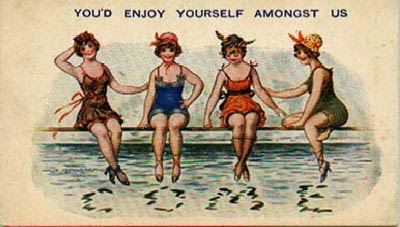
As the Victorian era passed into the Edwardian and Roaring Twenties, a market developed for bisque and china bawdy novelties and figurines of women in revealing outfits. Although now most of these figurines seem more coy and cute than ribald and risque, in their time they symbolized the casting off of the perceived restraints of the Victorian era.

These little lovelies included bathing beauties, who came clad in swimsuits of real lace or in stylish painted beach wear, as well as mermaids, harem ladies, and nudies, who were meant to wear nothing more than an engaging smile. Also produced were flippers, innocent appearing figurines who reveal a bawdy secret when flipped over, and squirters, figurines that were meant to squirt water out of an appropriate orifice.

Most were manufactured in Germany from the late 1800s through the 1930s, often showing remarkable artistry and imagination, with Japan entering the market during World War I.

Showing posts with label mannequin. Show all posts

Thursday, November 20, 2025

Striking a pose. . . .

And she most certainly is striking! At 17 inches tall, this lovely lady was no doubt intended to be a countertop display mannequin. Jointed only at the shoulders, she is of a heavier celluloid material, with rods in the soles of her feet that fit into holes in her marbleized base. There are no marks, not even on her domed pate under the blond mohair wig. I have seen this and similar mannequins represented as German from the 1920s, but I know that somewhere years ago I saw this same mannequin identified as by the French company Petitcollin from the 1930s-40s.


Her facial painting resembles that of earlier and larger Petitcollin dolls, with beautifully painted eyes with a white highlight to the left of the pupil, shading on the upper eyelids, and heart-shaped red lips.


UPDATE: The "Les Poupées de Mariline," a French website dedicated to dolls and doll restoration, identifies this beautiful belle as by Petitcollin: https://www.restauration-de-poupees.fr/en-gb/reconnaitre-les-baigneurs-celluloid#Petitcollin

UPDATE II: I heard from Les Poupées de Mariline, who confirmed that this fine figure "is a rare decoration figure from Petitcollin around 1930. The base is generally made of plaster and celluloid on. It is not a toy. This production was destined to be dressed. Decoration dolls were very current between 1925 and 1935. I found information in the Elisabeth Chauveau book about French production of celluloid." I will now have to locate a copy of that book!
 

Thursday, July 26, 2018

Otra Mujer de Misterio

Spain appears to be the land of mujeres misteriosas.  This unusual and sultry señorita recently arrived from that country.  Of a hollow papier mache material this exotic beauty is 17 inches tall,  Her size and the fact that her arms are on adjustable wires (which would have allowed her to be more easily dressed and posed) indicate that she may have been intended as a countertop mannequin.  Those arms are bisque, tinted brown, and had I not seen earlier the same model with the identical style of bisque arms, I would have thought they were replacements.  


The other example was fair complexioned with pink bisque arms and looking closely at her face and hairline, it does appears she may have started out with a lighter skin tone.  


However, her original wig certainly indicates she was created to be an olive-skinned Spanish beauty.


She is superbly sculpted, both back and front, from her shapely legs to her flirtatious face.


There is a single tantalizing clue to this baffling beauty's origins.  On the back of her base are the initials "M" and "R" intertwined in a circle, which would seem to indicate either her manufacturer or designer.  However, I have been unable to track down the name behind these initials.  


Thursday, October 5, 2017

The Mystery Deepens

Earlier in this blog I posted about a mujer de misterio, a señorita from Spain who at first glance appeared to be a fashion figure from Galluba and Hofmann, but in fact was a replica made of plaster.  She now has a sister, also from Spain.  This lovely lass also has a mohair wig, which in this case appears to be original, arms jointed at the shoulders, and molded off-white combination underwear ending just above knees.  Standing on her base, she is 16 inches tall.


She has all the charming characteristics of a Galluba gal, including the perfect oval face, large intaglio eyes, the long slim neck, and surprisingly wide shoulders.  


Her elegant outfit of velvet and lace appears to be all original and is beautifully made.


Underneath are several petticoats trimmed in fine lace and lace knickers with delightful ribbon garters (one could argue this is superfluous as she has molded underwear underneath, but I am glad that her mysterious maker made this extra effort!).  The right or left foot slightly forward is common to Galluba's fashion ladies, but the dainty little feet with multi-strap pumps are not typical footwear for Galluba ladies, who tend to have footwear with elongated toes so that the tips of their shoes are often visible under the hems of their long Edwardian skirts.  Perhaps a little artistic license by her unknown creator?


Her base, trimmed in lavish red velvet and gold braid, is the top of a round box (the bottom is lost to time).  The only mark is “2270/60” in pencil written inside the lid.  One wonders if the box held sweet treats or perfumed power.  Whatever its contents, this must have been some gargantuan  gorgeous gift!  This lady and her lacy outfit are in wonderful condition considering time and the fragility of the materials.  Clearly someone treasured this beautiful box-lid belle for many, many years. 


Spanish craftsmen for centuries have created religious figures and icons out of wood and plaster.  It appears now that sometime in the early 1900s a Spanish artisan decided to branch out into more modern mannequins to adorn shop windows and gift boxes and used the bisque belles of Galluba as a model.  Perhaps someday a catalogue, advertisement, or business card will come to light to help solve the mystery of these lovely ladies of Spain.