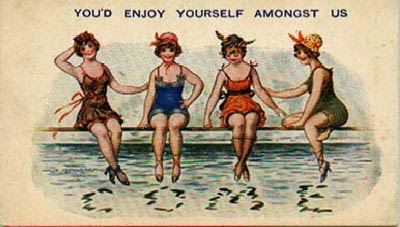
I have added more pictures of pages and text from the original Hertwig and Company catalog, including the first appearance of badedame (bathing lady).
Postcard Image
As the Victorian era passed into the Edwardian and Roaring Twenties, a market developed for bisque and china bawdy novelties and figurines of women in revealing outfits. Although now most of these figurines seem more coy and cute than ribald and risque, in their time they symbolized the casting off of the perceived restraints of the Victorian era.
These little lovelies included bathing beauties, who came clad in swimsuits of real lace or in stylish painted beach wear, as well as mermaids, harem ladies, and nudies, who were meant to wear nothing more than an engaging smile. Also produced were flippers, innocent appearing figurines who reveal a bawdy secret when flipped over, and squirters, figurines that were meant to squirt water out of an appropriate orifice.
Most were manufactured in Germany from the late 1800s through the 1930s, often showing remarkable artistry and imagination, with Japan entering the market during World War I.
Showing posts with label catalog. Show all posts
Thursday, October 7, 2021
Saturday, May 8, 2021
Bring on the Dancing Girls!
Certainly any collector would want to bring on any dancer as delicate and delightful as this lovely lass. Of excellent porcelain and beautifully sculpted and decorated, she is 11 inches tall, not including her wooden base.
Although unmarked, she appears in the 1911 catalog of Dressel, Kister, and Company, confirming not only her maker, but that her base is original as well. This must have been a popular pose, as Dressel offered this luscious light of the harem in a variety of sizes and outfits (or no outfit).
Joining the chorus line are two more Dressel dancing damsels. All have their tresses in coiled braids over their ears and while the gorgeous gal in green has donned a turban, the other two wear their hair in a low chignon in the back. The nubile nude is bisque, while the other two are china.
Another image from the Dressel catalog.
A back view reveals that these ladies are equally lovely both coming and going. The details and workmanship are exquisite. For example, the center dancer's outfit has been decorated to give the appearance of sheerness and she is stepping out of her slipper as she rises on tiptoe.
This antique cigarette case carries a nearly identical image. Dressel often copied popular paintings and postcards of the day, but so far I have been unable to locate the original image that appears to have inspired both the case and figurines.
Thursday, December 5, 2019
Fancy That!
Another old catalog page, this one from a partial catalog from an unidentified wholesaler or exporter. With descriptions in German, French, English, and Spanish, the catalog offered a wide variety of toys and dolls and appears to date from the 1920s.
At the bottom right corner of the page is a trio of bathing beauties.
The accompanying price page does not contain any specific description of the little bathers, lumping them in with a group of googly girl dolls and one oddly-placed religious figure as "Fancy dolls of papier mache, painted eyes." There is a notation for "04329," the seated bathing belle with the paper parasol, stating "Silk," apparently describing the ribbon that appears to be tied around her waist. The other two little ladies, "04330" and "04331" have no notations, which suggests that their costumes are molded and painted.
Thursday, November 21, 2019
Aeroplane Service, Subway Prices
Another old catalog featuring bathing belles, this one from S.K. Novelty Company in Brooklyn, New York. Its offerings are the type of composition cuties and quasi-Kewpies found on carnival midways, where barkers urged rubes to, "Step right up and win a Kewpie doll for the little lady."
The catalog opens with "Sweetums, the Belle of the Bathers." The price of $11.50 seems extremely extravagant, but it is for a dozen dolls, as made clear on other pages. The catalog states this bather is bisque, but I suspect it is a "bisque finish" advertised on subsequent pages. In the late 1910s into the 1920s, there was a fad for comic googly-eyed bathing beauty figurines. In 1919, Playthings, a magazine for the toy trade, announced that the novelty vogue of the year was wide-eyed "beach dolls" made of wood fiber or composition. The most famous of these flirtatious flapper figures was "Splash Me," copyrighted in 1918 by Genevieve Pfeffer.
Another starry-eyes seaside siren is "Miss Neptune, Jr.," the "Star of the Sea." She appears to be Sweetums in a different color scheme. Perhaps her fuller wavy wig is the reason for the dollar difference in the price.
Next is a cadre of composition Kewpie doll knockoffs gaudily gowned in bits of silk, ribbon, and "marabough" (I think the copywriter meant marabou), some with "wonderful" or "beautiful" wigs. No doubt the material was of the cheapest quality and the costumes simple, but they certainly added to the doll's commercial appeal.
The page featuring "Lovie, Jr." clarifies that the price is for a dozen. Lovie could be purchased with or without a wig, the bald version being $2 cheaper by the dozen.
The copywriter lays it on pretty thick for "Lotus Flower." Note that little Lotus is advertised as having a "bisque finish."
Lovie, Jr. reappears, now in a knit bathing suit and cap.
Another offering in a knit bathing outfit, as well as a mohair wig.
The hand-written margin note states that, "This is absolutely the largest novelty doll in the world." She is certainly sizable at 18 inches tall and could be ordered with or without a wig.
The final page declares that the company has many other items not listed in the catalog. It proudly proclaims the company's motto, "Aeroplane service and subway prices."
Thursday, October 10, 2019
Waxing Elegant
Although wax half dolls and bathing belles were popular decorative items in the early 1900s, few have survived. Bisque and china will certainly shatter or chip if dropped or handled roughly, but otherwise can stand the vicissitudes of time and temperature. A waxen lass, whether solid or a wax coat over plaster or chalk, has a far more ephemeral epidermis, easily scratched or dented, subject to cracking in cold weather or softening on hot days. The features painted on top of the wax tend to rub off or fade over time. This original catalog from the Germany company of Ernst Scheddin offering tea doll heads ("teepuppenköpfen") and wax figures ("wachsfiguren") shows the delightful variety and the delicate beauty of these vulnerable belles. I have not been able to find any background information of this factory, but the catalog most likely dates from the late 1910s though the 1920s.
The introduction states that while the catalog displays the factory's standard articles, there are many variations and, on request, similar figures can be created in wax or chalk.
The top row of "tea doll heads" have a wax coating and can be ordered with a smooth or matte finish. The second row are of wax.
The top picture displays wax heads for assembling dolls or pincushions, while the lower offers cute chubby cherubs in wax.
Wax half dolls with movable full arms and wonderful wigs.
"Aktfiguren," a fancy way of saying nekkid ladies. . . .
Wax figures offered dressed with bits or ribbon or displayed on fancy pincushions.
These are supplemental pages offering additional decorative damsels.
Certainly my favorite page, displaying bathing beauties both nude ("nackt") or painted with glitter ("flitterbemalung"), some posing with paper parasols.
Friday, May 18, 2018
Dressel Kister Sisters
Although unmarked, this china charmer is a documented model from Dressel, Kister, and Company. Of beautiful glowing pale porcelain, with soft blushing on her hands, elbows, cheeks, breasts, and knees, this 7-inch long languorous lady is molded in a sitting position.
She has the striated grey eyebrows and large languid brown eyes so often found on Dressel damsels, but instead of the typical molded grey tresses, a wig of mohair curls covers her bald solid pate.
Here is the identical wasp-waisted model, but with the grey molded hair incongruously found on so many of Dressel's nubile nymphs.
Like her eyebrows, her tresses are streaked to give the illusion of separated strands of hair. Her blue-grey eyes have sultry shadowing underneath.
Here is the molded-hair version pictured in the company's 1911 catalogue. She apparently came perched on her personal pedestal.
Subscribe to:
Posts (Atom)