Postcard Image

Postcard Image
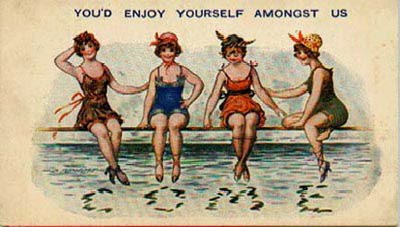
As the Victorian era passed into the Edwardian and Roaring Twenties, a market developed for bisque and china bawdy novelties and figurines of women in revealing outfits. Although now most of these figurines seem more coy and cute than ribald and risque, in their time they symbolized the casting off of the perceived restraints of the Victorian era.

These little lovelies included bathing beauties, who came clad in swimsuits of real lace or in stylish painted beach wear, as well as mermaids, harem ladies, and nudies, who were meant to wear nothing more than an engaging smile. Also produced were flippers, innocent appearing figurines who reveal a bawdy secret when flipped over, and squirters, figurines that were meant to squirt water out of an appropriate orifice.

Most were manufactured in Germany from the late 1800s through the 1930s, often showing remarkable artistry and imagination, with Japan entering the market during World War I.

Showing posts with label harem. Show all posts

Friday, September 18, 2026

Serving the Seraglio

Recently I acquired these two unusual dark-skinned children in the remains of their original silk clothing. They have molded golden slippers with upturned toes and are kneeling in a gesture of obeisance.


The taller of the pair, at around 3.5 inches, has realistically modeled Black features and a gentle expression. 


These figures are part of a harem series by the German maker Willian Goebel. Here are some of that scarce series from my collection.  In the center is the sultan smoking a pipe. He has molded golden slippers similar to those worn by the two children and his original dark gold cloth turban. Now clad only in his molded loincloth with painted "gems," he no doubt at one point was dressed, most likely in silken harem pants and some sort of top or vest. The graceful gesturing woman next to him has a similar molded loincloth and retains only her elaborate original wig. To her left is a smaller sultana feeding her pet parrot still dressed in her original (if melting) harem parts and tall turban. The only other harem inhabitant in her original outfit is the lovely lounging lady with a molded fan. The lissome lass lying next to her plays a molded tambourine and the kneeling beauty, who has been redressed and re-wigged, admires herself in a mirror. Without the silk and golden braid clothing, often lost to the decades, it may be difficult to determine whether a bisque beauty belongs on the beach or in a harem, but often the ladies of the harem series hold an object and have heeled slippers in unusual colors, like lilac or turquoise. Goebel bathing belles generally went barefoot or wore ballet-type bathing shoes, plus, unlike companies such as Galluba and Hofmann, who dressed its bathers in suits of net, Goebel's seaside sirens had their swimsuits painted on, typically in broad stripes. 


There is one other inhabitant, just to the sultan's right, a very dark-skinned boy in his original oversized turban. His shredded blue harem pants expose the molded pants underneath and his molded slippers have upturned toes In his hands he holds a small silk pillow. This charming child is the stereotypical "Nubian serving boy" often found in the imaginary Orientalist imagery of the West. 


Whether such children actually existed in Eastern harems, this image is found in western art from the 1700s to well into the 20th century. In 18th century Europe aristocrats often flaunted their wealth by purchasing a young Black boy as a servant or page and dressing him in a flamboyant turban and colorful costly clothing. Willam Hogarth satirized this fashion in his 1742 painting, "Taste of the High Life," as seen in this detail.  


An enslaved serving boy is pictured again in Hogarth's six-painting series, "Marriage-A-la-Mode." This detail is from the fourth painting in the series, "The Toilette."


The Nubian boy serving his sultry sultana also often appeared in the exotic imagery of Austrian bronzes.


This 1912 pochoir by artist George Lepape illustrating Paul Poiret's Orientalist-inspired fashions includes a Nubian serving boy, as if to emphasize the link between East and West.


Thursday, August 6, 2026

I Put a Spell on You. . .

Because you're mine
Because you're mine. . . .

"I Put a Spell on You," Screamin' Jay Hawkins, 1956

This sensual sorceress, clad only in the barest of baubles and beads, does cast an enchanting spell. She is one of the series of harem ladies by Galluba and Hofmann, wearing elaborate, if exiguous, outfits of molded golden beadwork and jewels. Like some of the series, she is colored only the palest cream with her features picked out in tans and brown, giving her the look of an ivory carving. Just 4.5 inches tall, she is incised under her base "9688." The company used a 9000 series on many of its lovely odalisques. 


Saturday, May 8, 2021

Bring on the Dancing Girls!

Certainly any collector would want to bring on any dancer as delicate and delightful as this lovely lass.  Of excellent porcelain and beautifully sculpted and decorated, she is 11 inches tall, not including her wooden base.


Although unmarked, she appears in the 1911 catalog of Dressel, Kister, and Company, confirming not only her maker, but that her base is original as well. This must have been a popular pose, as Dressel offered this luscious light of the harem in a variety of sizes and outfits (or no outfit).


Joining the chorus line are two more Dressel dancing damsels. All have their tresses in coiled braids over their ears and while the gorgeous gal in green has donned a turban, the other two wear their hair in a low chignon in the back. The nubile nude is bisque, while the other two are china. 


Another image from the Dressel catalog. 


A back view reveals that these ladies are equally lovely both coming and going. The details and workmanship are exquisite. For example, the center dancer's outfit has been decorated to give the appearance of sheerness and she is stepping out of her slipper as she rises on tiptoe.


This antique cigarette case carries a nearly identical image. Dressel often copied popular paintings and postcards of the day, but so far I have been unable to locate the original image that appears to have inspired both the case and figurines.


Thursday, May 11, 2017

Wearing Baubles, Bangles, and Beads

Baubles, bangles,
Hear how they jing, jing-a-ling-a,
Baubles, bangles,
Bright, shiny beads.
Sparkles, spangles,
My heart will sing, sing-a-ling-a,
Wearing baubles, bangles and beads.
I'll glitter and gleam so,
Make somebody dream so,
That someday he may buy me,
A ring, ring-aling-a,
I've heard that's where it leads,
Wearing baubles and bangles and beads.

Kismet, 1953 musical by Robert Wright and George Forrest

This sultry sultana, glittering and gleaming in her molded baubles, bangles, and beads, would be the dream of any collector.  By the German firm of Galluba and Hofmann, this enticing odalisque is only 2.25 inches high.  She is faintly incised "9000" under her hips.


Despite her small size, she has the same excellent bisque and exquisite detail that Galluba lavished on on its larger ladies.


Thursday, November 24, 2016

It's a Stretch

This sleepy sultana, luxuriating a sensual stretch, represents how many Americans will no doubt feel after stuffing themselves with turkey and stuffing (although, admittedly most Americans would probably not look quite as fetching in a barely-there jeweled bra and sheer skirt). By the German firm of Galluba and Hofmann, she is a variation of a mold used by the company for a bathing beauty.  Decorated in creams and browns to resemble an ivory carving, this undulating odalisque is 8 inches long.  Of excellent bisque, this luscious lady is incised underneath “9724.”


A case up of her face and upper torso.  Her gold and bejeweled top is not merely painted on, but molded as a series of raised dots.