Postcard Image

Postcard Image
As the Victorian era passed into the Edwardian and Roaring Twenties, a market developed for bisque and china bawdy novelties and figurines of women in revealing outfits. Although now most of these figurines seem more coy and cute than ribald and risque, in their time they symbolized the casting off of the perceived restraints of the Victorian era.

These little lovelies included bathing beauties, who came clad in swimsuits of real lace or in stylish painted beach wear, as well as mermaids, harem ladies, and nudies, who were meant to wear nothing more than an engaging smile. Also produced were flippers, innocent appearing figurines who reveal a bawdy secret when flipped over, and squirters, figurines that were meant to squirt water out of an appropriate orifice.

Most were manufactured in Germany from the late 1800s through the 1930s, often showing remarkable artistry and imagination, with Japan entering the market during World War I.

Showing posts with label austria. Show all posts

Thursday, June 19, 2025

Toweling Off

This bronze bathing belle poses on her marble pedestal. Wrapped in a towel, perhaps she is contemplating a dip in the waves, or maybe she is resting after a refreshing swim, as the ribbons to her bathing cap are untied, dangling down her back. Her ballet-style bathing slippers are bound with bows at her ankles. 

However, her towel swings open on a hinge, revealing that the bather has neglected to do a bit more than simply tie her bathing cap. The lovely lass has a soft golden patina, while her towel and bathing cap are darker bronze. 


Incised "Austria" on the back, this 6.5-inch mechanical bronze is yet another example of Austrian foundries' fascination with seaside wardrobe malfunctions. Beginning in the mid-19th century, Austria was famed for its foundries and ateliers producing finely crafted artistic bronzes. Although works covered a wide variety of genres, including classical studies, animals and nature, comic subjects, and Orientalist images, one speciality was erotic bronzes, often with the naughty bits initially concealed, only to be revealed by a push of a button or the moving of a piece of metal drapery. 


Thursday, April 27, 2023

Age of Bronze, Finale

This bronze bathing beauty is the last, but not least, of the trio of cast coquettes from the previous postings. She is clad in a bathing outfit consisting short-sleeved nifty nautical blouse and swim shorts to her mid-thigh. Ballet-style bathing slippers adorn her slender ankles and feet. Resting by her knees is wide-brim sun hat nearly identical that lying by the side of the statuesque siren from the previous posting, so they are almost certainly from the same foundry. Her smooth skin has a golden patina, while the bow in her chignon and sun hat are pale red, the blouse silvery, and shorts and shoes have a soft greenish patina. Just 3.5 inches long, she is delicately modeled with fine details. Like the prior bronze beauties, she is unmarked, but mostly likely was made in Austria around the early 1900s.


Friday, March 31, 2023

Age of Bronze II

Another bronze bathing beauty, a bigger sister to the metal miss in the last posting. Reclining in a form-fitting tank swimsuit that clings to very ample curve, this beach belle is 4.5 inches long and 1.5 inches high. Her skin has a golden patina (no doubt from all that seaside sunbathing), with a very pale green patina to her swimsuit and touches of red on bow in her hair and the sun hat lying next to her. The sculpting and casting are excellent, with even tiny details like the waves in her luxurious hair and the texture of her knit bathing suit captured in bronze. Like the prior bronze beauty, she is unmarked, but mostly likely was made in Austria around the early 1900s.

Friday, March 17, 2023

Age of Bronze

This lissome miss is cast in bronze. Although only 2.5 inches tall and high, she is superbly sculpted, from the waves in her thick tresses to the tiny bows on the toes of her ballet-style bathing slippers. Her skin has a soft glowing golden patina, while the nautical blouse of her bathing suit is subtly silvered and her skirt and shoes have a greenish patina. A touch of red tints the bows in her hair and around her slender ankles. Although unmarked, this bronze beach belle is most likely Austrian. Beginning in the mid-19th century, Vienna became the center of many foundries and ateliers producing a wide array of finely crafted artistic bronzes to adorn the homes of those wishing to subtly display their taste and wealth. Although pretty and petite, she is surprisingly heavy for her small size and perhaps could have served as a paperweight for a gentleman's desk. 


Thursday, July 28, 2022

Getting Bronzed

This languorous lass appears to be working on her tan, but she is already a beautiful golden bronze. Just 5 inches long, this sensual sculpture is exceptionally heavy for her size, making her a pulchritudinous paperweight for some gentleman's desk. She has a gilt patina, except for her bathing cap, which has a reddish tint. The sculpting is superb, from her supple curves to her bathing suit with its natty nautical collar to the ribbons on her ballet-style bathing slippers. 


Under her left hip is the "B" within an urn mark of the Viennese foundry of Franz Xaver Bergmann and "Austria."


Thursday, October 14, 2021

Basket (Chair) Case

This bashful bronze bathing belle peeks through the drapery of her hooded wicker beach chair. Such chairs were often rented to beach goers by the resort hotel or spa and the deluxe versions came with curtains that could be pulled down for further protection again the sun and wind or for just a bit of privacy.  All that can be seen of this demure damsel is her shyly smiling face and her slender feet clad in dainty bathing slippers.


But atop the dome of the chair's "wicker" hood is a little button. . . . Oooh, what does this button do?

It releases a latch, so that the front swings open, revealing that the lovely lass remembered to bring her bathing slippers, but forget to pack the rest of her swimwear. The 7.5 inch-tall mechanical bronze sculpture is softly patinated in several delicate shades. The curtains are a greenish gold and the drapery framing the top edge of the chair is a pale rose. The bare bather's hair, styled in a wavy chignon, and her bathing slippers, tied at the ankle, have a pinkish-gold patina, while her body is a soft gold. She sits on a reddish cushion with golden trim.


The back base of the chair is stamped "Austria" and incised "C. Thenn gesetzlich geschutzt." "C. Thenn" was one of the names used by the Austrian sculptor Carl Kauba. Born in Vienna in 1865, Kauba studied both at the Academy of Fine Arts in Vienna and in Paris. His bronzes are renown for their intricate and realistic detail and the skilled application of multiple colors of patina. He is best known for his images of the American West (although there is some dispute whether he ever actually traveled to America or was simply inspired by the Wild West fantasies of German author Karl May) and his naughty novelty sculptures which went from innocent to improper by pressing a hidden button or lever. "Gesetzlich geschutzt," means that patent rights have been granted and registered for the design.


Sunday, June 13, 2021

Come Lie With Me

Come lie with me and be my love
Love lie with me
Lie down with me
Under the cypress tree
In the sweet grasses
Where the wind lieth
Where the wind dieth

Lawrence Ferlinghetti (1919-2021), 1961

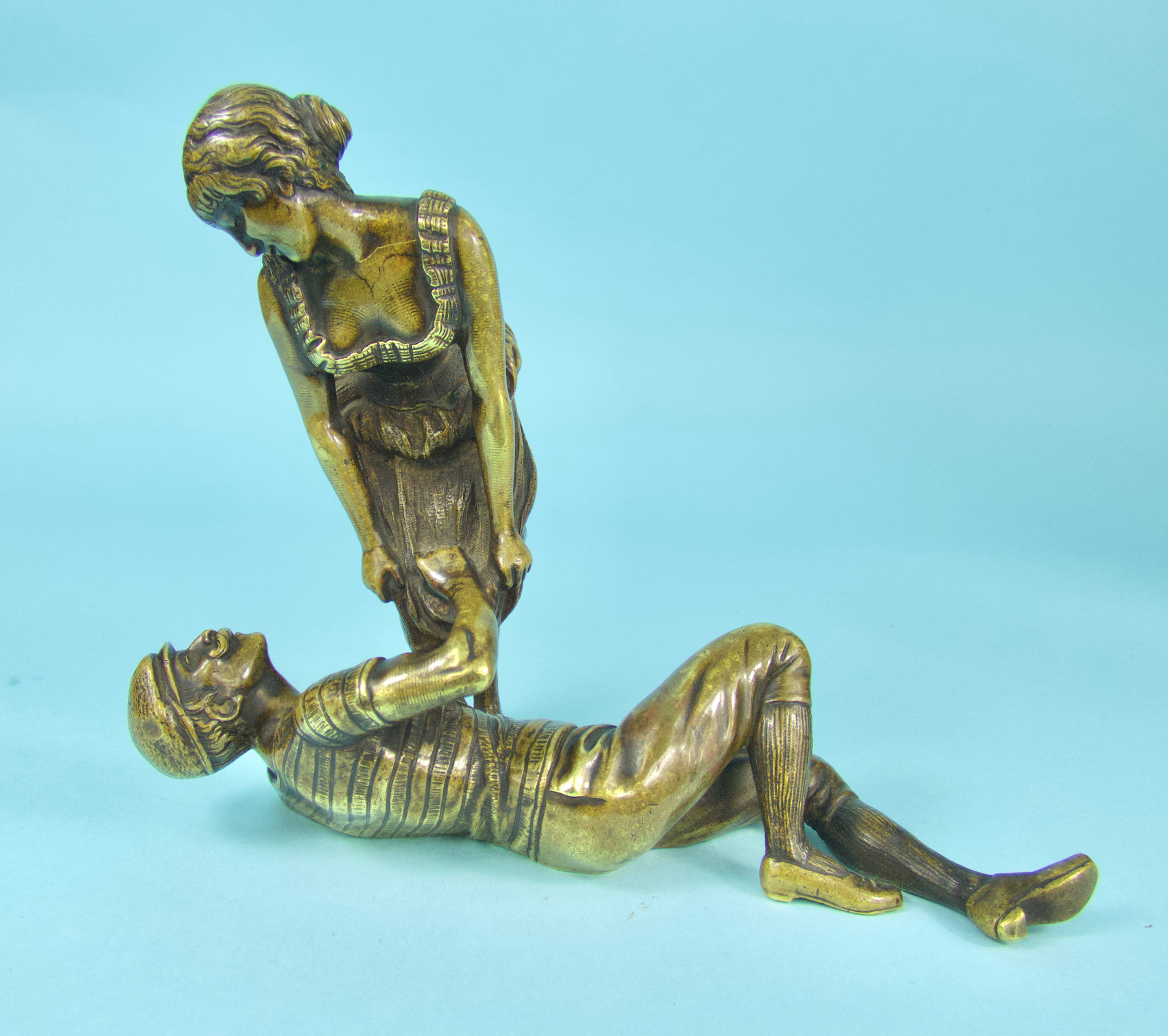
I have gotten a bit behind on my blog, but I think this charming bronze makes up for my neglect. It features two lovers at the seaside, the man, sprawling on the warm sand, gently urging his lovely lady to join him as he tugs at her skirt. She demurs, but her coy reluctance is certainly simply pro forma. How could she possibly resist such a magnificent mustache?!


Of golden bronze, this superbly detailed sculpture is 5 7/8 inches long and 4.25 inches high. 


Underneath man is marked "M," "813" in an oval, and "S." This appears to be the mark of Moritz Spitz, one of the many foundries operating in Austria from the late 1800s through the early 1900s that created fine quality miniature bronze sculptures. 


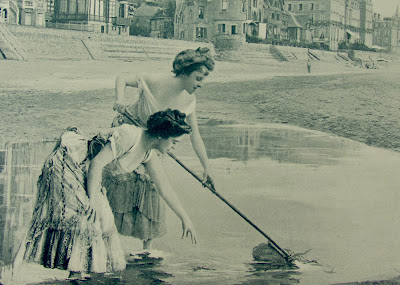
The slim yet muscular man wears the sort of casual outdoor gear that men of the late Victorian period through the early Edwardian period might don for a seaside stroll, a golf cap, short-sleeved knit striped shirt, knickers, ribbed socks, and walking shoes. His lady's outfit, with the low-cut sleeveless top and skirt raised to expose her lower legs clad in ribbed stockings and low-heeled shoes, is more of a mystery. It is not at all typical of the bathing suits of the era and certainly not something a proper woman would wear out on the street. However, the following photographs provide a clue. They are by  French photographer Léopold-Émile Reutlinger, renown for his portraits of the most famous, and infamous, beauties of the Belle Epoque, from opera singers to performers from the Folies Bergères, as well as artistic erotic pictures, which were reproduced widely on postcards. The pictures are from "Le Panorama," a periodic art publication, and are entitled "Les Saisons, Etè"  (The Seasons, Summer), No. 7. Issued in 1899, the "art" consists wholly of nubile ladies in scanty swimwear carefully posed and photographed by Reutlinger; it appears that many of the portraits were actually taken in a studio and then transposed over seaside scenes. Several of these pictures portray pulchritudinous Parisiennes fishing in the shallows with nets for shrimp and tiny fish. They appear to have removed their outer blouses or jackets and tucked up their skirts around their waists allow them to wade in the low waves. While I doubt many women in reality would dare such extreme public dishabille as pictured by Reutlinger, his imagery certainly is not wholly imaginary and a younger woman, especially on a lonelier stretch of beach, might shuck off a few heavy outer layers of clothing and tuck up her skirt in order to better enjoy the sun and sea. Perhaps that is what this little bronze beauty (undoubtedly with the encouragement of her beau) has done.




Thursday, December 17, 2020

Wanna See My . . .Lady?

A number of posts on this blog have featured female figures with strategically placed kitty-cats, a double-entendre of "pussy" as an affectionate name for a cat and as a vulgar reference to female genitalia. The Barrison Sisters built an entire vaudeville career in the 1890s by showing off their "pussies" on stage. This bawdy bronze is a slightly different play on pussy. A cute kitten sits on a marble base. Its realistic fluffy coat and appealing face are superbly sculpted, highlighted with a deep golden patina. Just 5 inches high, but with substantial heft, it could have served as a paperweight for a gentleman's desk.


Why a gentleman? Well, this prurient pussy swings open to expose a kneeling nude lady, smugly smiling as she clutches a cache of jewels. She has a subtler golden patina than her feline friend, and her hair and gems are a softly-tinted rose.


Almost obscured by the curls in the fur, "AUSTRIA" is stamped on the back rim of the cat. Beginning in the mid-19th century, Austria, particularly in Vienna, was famous for its foundries and ateliers producing finely crafted artistic bronzes. The works covered a wide variety of genres, including classical studies, animals and nature, comic subjects, Orientalist images, and even erotic images. Often the naughty bits were concealed in a seemingly innocuous subject, only to be revealed by a push of a button or lifting a up a piece of metal drapery. There is a wide variety of these Austria sculptures  concealing salacious secrets, with nubile nudes hidden within an assortment of owls, mice, sphinxes, mummy cases, Eastern idols, and, perhaps most appropriately, an iron maiden.


Thursday, November 29, 2018

Midnight at the Oasis. . . .

Send your camel to bed
Shadows painting our faces
Traces of romance in our heads
Heaven's holding a half-moon
Shining just for us
Let's slip off to a sand dune, real soon
And kick up a little dust

1973, written by David Nichtern, sung by Maria Muldaur

Completing the theme of erotic bronzes from fin de siècle Austria is this Middle Eastern maiden posing provocatively under a palm tree.  The palm fronds conceal a lightbulb and this lovely lamp is part of a series featuring various Arabic-inspired scenes under a sheltering palm.  Of cold painted bronze, it is unmarked, but is no doubt from one of the many Austrian foundries that produced finely sculpted and cast bronzes in the late 1800s through the 1930s.  A significant number of these bronzes engaged in Orientalism, with fanciful depictions of a mysterious, seductive, and decadent Middle East.  The lamp is 11 inches tall.


A close up of the barely-robed water bearer.  The cold painted patina is susceptible to wear, especially at any protruding edges, revealing glimpses of the gleaming bronze underneath


Thursday, November 1, 2018

What a dish!

According to the Merriam Webster dictionary, "dish" can refer to "a more or less concave vessel from which food is served" or "an attractive or sexy person." And this bronze beauty is a dish in all senses of the word!  Of dark bronze and creamy onyx, this dishy dame is eight inches tall.  She is beautifully sculpted and cast, from her smiling face to the clinging top that has slipped down to bare one breast. . . . 


. . . . to her ruffled undergarments and dainty bare feet.


Her upper torso lifts off, revealing that her tiered stony skirt is composed of three translucent nested onyx dishes (originally, there were four, but one has dish has disappeared over the decades).  The dishes could have been used for nuts or other nibbles, but I suspect they are more likely a set of fancy ashtrays, as there was a fad for artistic stone and bronze smoking paraphernalia in the early 1900s.


She is signed "Charles Austria."  Beginning in the mid-19th century, Vienna became the center of many foundries and ateliers producing finely crafted artistic bronzes to adorn the homes of those wishing to subtly display their taste and wealth.  I have not been able to find any information regarding "Charles," but the name could refer to the sculptor, the foundry, or perhaps even an exclusive store offering such expensive specialties.