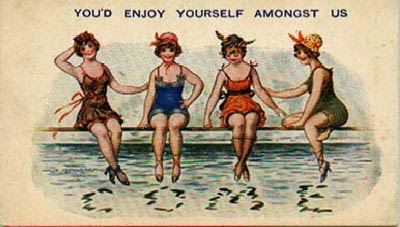
Postcard Image

Postcard Image
As the Victorian era passed into the Edwardian and Roaring Twenties, a market developed for bisque and china bawdy novelties and figurines of women in revealing outfits. Although now most of these figurines seem more coy and cute than ribald and risque, in their time they symbolized the casting off of the perceived restraints of the Victorian era.

These little lovelies included bathing beauties, who came clad in swimsuits of real lace or in stylish painted beach wear, as well as mermaids, harem ladies, and nudies, who were meant to wear nothing more than an engaging smile. Also produced were flippers, innocent appearing figurines who reveal a bawdy secret when flipped over, and squirters, figurines that were meant to squirt water out of an appropriate orifice.

Most were manufactured in Germany from the late 1800s through the 1930s, often showing remarkable artistry and imagination, with Japan entering the market during World War I.

Showing posts with label bathing beauty. Show all posts

Thursday, June 19, 2025

Toweling Off

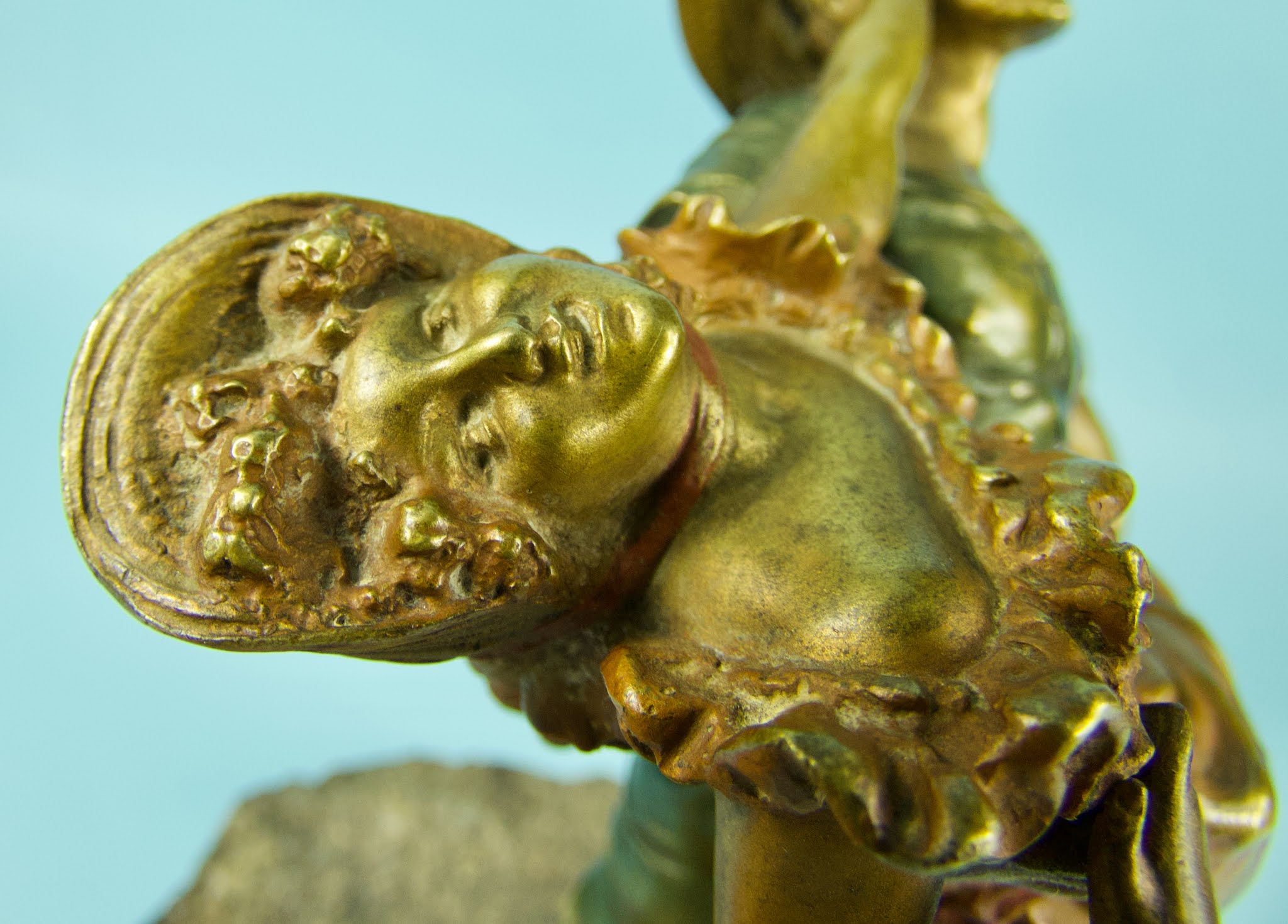
This bronze bathing belle poses on her marble pedestal. Wrapped in a towel, perhaps she is contemplating a dip in the waves, or maybe she is resting after a refreshing swim, as the ribbons to her bathing cap are untied, dangling down her back. Her ballet-style bathing slippers are bound with bows at her ankles. 

However, her towel swings open on a hinge, revealing that the bather has neglected to do a bit more than simply tie her bathing cap. The lovely lass has a soft golden patina, while her towel and bathing cap are darker bronze. 


Incised "Austria" on the back, this 6.5-inch mechanical bronze is yet another example of Austrian foundries' fascination with seaside wardrobe malfunctions. Beginning in the mid-19th century, Austria was famed for its foundries and ateliers producing finely crafted artistic bronzes. Although works covered a wide variety of genres, including classical studies, animals and nature, comic subjects, and Orientalist images, one speciality was erotic bronzes, often with the naughty bits initially concealed, only to be revealed by a push of a button or the moving of a piece of metal drapery. 


Thursday, November 21, 2024

Creepy Crawlers

The nude nymph cringing at the little crustacean crawling up her calf has appeared previously on this blog. By the German firm of Carl Schneider Erban, she is 4 inches long and is incised “15223” and “Germany," on her pincushion base. Her raven-haired companion in the same pose has lost her pincushion base but gained a rather daring off-the-shoulder striped bathing suit. Also 4 inches long, she shows how a clever manufacturer could tweak an existing mold to create a new model and expand a product line. 


She is incised “15150” under her lower hip. 


Thursday, August 1, 2024

All Bottled Up

This 14-inch tall clear glass bottle features a bathing beauty pressed against a pillar of stone as she appears to ponder whether to enter the unseen waves.

The modeling is extraordinarily detailed, from her flowing tresses held back with a scarf, the ribbed pattern on her bathing suit, and even the ballet-style ties of her bathing slippers. Underneath the bottle is marked "Depose," which is a French word indicating that the design has been registered. There is a rough pontil point in the center of the bottom. This bottle is attributed to Legras, a French maker of fine and utilitarian glass objects.


Legras was founded in 1864 by Auguste Legras at St. Denis, France. The company made elegant decorative glassware, including enameled and cameo cut pieces in the popular art nouveau and art deco styles. However, the company, which at one point employed nearly 1,300 workers, also specialized in more utilitarian glassware, including novelty liquor bottles. This image is a page from a catalog of  Eugéne Vincent & Cie, a Lyon wine and liquor distributor, illustrating some of the novelty bottles its adult beverages could be ordered in. On the center row, second to the left, is what appears to be the same bathing belle bottle. Legras was sold in 1928, becoming Verreries et Cristalleries de St. Denis, but continued manufacturing art glass based on Legras models through the early 1930s. I would date the bottle from the late 1880s through 1900.


Thursday, June 27, 2024

Man, oh man!

Anyone who has followed this blog knows that one bathing beauty (or should I say beach beau?) I have been searching for is the male version of the Galluba and Hofmann bather, pictured in this catalog page on the second from the top row at the far left edge. 


The elusive gentleman has finally deigned to join my collection, much to the joy of my bevy of bisque beauties. Here he is in all his male glory (well, not exactly all, as, shall we say, he is in no need of a fig leaf).  Of excellent bisque, he is 4 inches high and 4.5 inches long. He is superbly sculpted, with detailed musculature. Unlike Galluba's bathing belles, who are literally the fairest of the fair, his complexion is a golden tan.


He has strong, handsome male features. With those sultry dark eyes and sleek raven locks, he could pass for a matinee idol of the silent silver screen.


In fact, I think he gives off a bit of a Rudolph Valentino vibe. . . 


A dash of dark shadowing emphasizes his cheekbones.


Under his left thigh he is incised with "80423 P.P." This is the same model number that appears on the catalog page. 


As seen on the catalog page, and in this example from the Toy and Miniature Museum of Kansas City, originally he wore a black knit tank suit. However, I don't think that I am going to redress him. It seems such a shame of cover up those perfect pecs and amazing abs. . . .


not to mention that bodacious bum!


Thursday, May 30, 2024

Judging a Book by Its Cover. . . .

This hand-painted suede book cover was a souvenir of Atlantic City, New Jersey. These suede souvenirs were apparently quite a fad for a time, because I have come across examples commemorating other vacation destinations, all having the same basic construction, but different painted decorations suitable to the tourist site, as well as photo and postcard albums. This book cover is 8.5 inches by 5.5 inches and considering its wonderful condition, apparently did not spend too much time in the sand and sun at the shore. The owner's initials are gracefully stamped on the upper corner.


It is not only the book inside that may beguile, because the cover features a lithe and lovely bathing beauty seated by the sea and shaded by her big green parasol.


Inside is an attached bookmark, with a rather fortune-cookie motto and the date "1928."


Thursday, December 21, 2023

Gorgeous Goebel

This large and lovely bathing beauty is an unusual example from the German firm of William Goebel. Her excellent china was made with precolored pink slip and her orange-red tank suit is cold-painted. 


Her exquisite face is framed by her glossy black bobbed hair and her slender hands gesture gracefully.


Underneath she is incised with Goebel's crowned intertwined "G" and "W," as well as "F.N. 757." This use of capital letters is also typical of Goebel. This big beautiful bathing belle is 6.5 inches long and 3 inches high.


Friday, October 6, 2023

Pleased as Punch!

This bathing beauty lamp has appeared previously on this blog. A similar lamp had once been offered as a prize on a punch board, a picture of which appeared in that post.


I have finally found an original of that punch board (sometimes referred to as punchboard) to add to my collection. Early punch boards were a homemade affair, a tavern owner or innkeeper drilling multiple holes in a wooden board, inserting a small roll of paper with a number written on it in each hole, then sealing the holes. Patrons could purchase a chance to punch out one or more holes and if they drew out a winning number, won cash or some other prize. In 1905, the first cardboard version of this game was patented. These inexpensive mass-produced games became popular in bars, drugstores, barbershops, and other venues as a trade stimulator and they were produced in a wide variety of sizes, colors, and themes (such as sports or pin-up girls). For a low price, typically anywhere from a nickel to a quarter, the patron was given a metal stylus (or, as in this example, simply used a pencil) and allowed punch out one or more holes to reveal a number. If the number matched the winning number on the punchboard (here secured behind the gold foil seal), the lucky patron won cash or another prize. Punch boards were popular games through WWII, but states began cracking down on them as illegal gambling devices. Criminal gangs also controlled much of the punch board trade. One common scam was for the maker of the punch board to create a key or map of the winning holes, allowing a confederate or the venue owner to make off with the top prizes. 


On this card, each punch is labeled with a female name. There are some wonderful "old-fashioned" monikers rarely heard today.


The back of the card includes a table with the same list of names. In some punch boards, there was a slip of paper behind the hole which the patron pulled out to reveal his or her number. I suspect that with this game, the table served as a key, with a number written down next to each name.


Thursday, April 27, 2023

Age of Bronze, Finale

This bronze bathing beauty is the last, but not least, of the trio of cast coquettes from the previous postings. She is clad in a bathing outfit consisting short-sleeved nifty nautical blouse and swim shorts to her mid-thigh. Ballet-style bathing slippers adorn her slender ankles and feet. Resting by her knees is wide-brim sun hat nearly identical that lying by the side of the statuesque siren from the previous posting, so they are almost certainly from the same foundry. Her smooth skin has a golden patina, while the bow in her chignon and sun hat are pale red, the blouse silvery, and shorts and shoes have a soft greenish patina. Just 3.5 inches long, she is delicately modeled with fine details. Like the prior bronze beauties, she is unmarked, but mostly likely was made in Austria around the early 1900s.


Friday, March 31, 2023

Age of Bronze II

Another bronze bathing beauty, a bigger sister to the metal miss in the last posting. Reclining in a form-fitting tank swimsuit that clings to very ample curve, this beach belle is 4.5 inches long and 1.5 inches high. Her skin has a golden patina (no doubt from all that seaside sunbathing), with a very pale green patina to her swimsuit and touches of red on bow in her hair and the sun hat lying next to her. The sculpting and casting are excellent, with even tiny details like the waves in her luxurious hair and the texture of her knit bathing suit captured in bronze. Like the prior bronze beauty, she is unmarked, but mostly likely was made in Austria around the early 1900s.

Friday, March 17, 2023

Age of Bronze

This lissome miss is cast in bronze. Although only 2.5 inches tall and high, she is superbly sculpted, from the waves in her thick tresses to the tiny bows on the toes of her ballet-style bathing slippers. Her skin has a soft glowing golden patina, while the nautical blouse of her bathing suit is subtly silvered and her skirt and shoes have a greenish patina. A touch of red tints the bows in her hair and around her slender ankles. Although unmarked, this bronze beach belle is most likely Austrian. Beginning in the mid-19th century, Vienna became the center of many foundries and ateliers producing a wide array of finely crafted artistic bronzes to adorn the homes of those wishing to subtly display their taste and wealth. Although pretty and petite, she is surprisingly heavy for her small size and perhaps could have served as a paperweight for a gentleman's desk. 


Thursday, July 28, 2022

Getting Bronzed

This languorous lass appears to be working on her tan, but she is already a beautiful golden bronze. Just 5 inches long, this sensual sculpture is exceptionally heavy for her size, making her a pulchritudinous paperweight for some gentleman's desk. She has a gilt patina, except for her bathing cap, which has a reddish tint. The sculpting is superb, from her supple curves to her bathing suit with its natty nautical collar to the ribbons on her ballet-style bathing slippers. 


Under her left hip is the "B" within an urn mark of the Viennese foundry of Franz Xaver Bergmann and "Austria."


Thursday, July 14, 2022

What are the Wild Waves Saying?

As they roll upon the shore
What are the wild waves saying?
As they roll in more and more
They seem to say "I adore you
And I want your love to share"

Bonnie Beach and Johnny Noble, 1937

Kneeling on a round powder box shaped like an oversize hassock, this bathing belle lifts a sizable snail shell to her ear, no doubt to hear the roar of the ocean's waves. Of excellent china, this beautiful box is six inches tall and wide. 


 This svelte collector of sea shells is superbly modeled. 

Incised underneath is the Sitzendorf Porcelain Factory crown and crosshatched "S" mark. The company appears to have created a series of seaside-inspired powder boxes, as this bathing beauty's crabby sister appeared earlier on this blog.


Thursday, April 21, 2022

French Flirt

At first glance this big-eyed bathing belle appears to be another of the wide variety of chalkware or composition "beach dolls" which became so popular beginning in the late 1910s, such as the Splash Me dolls of Genevieve Pfeffer or the carnival cuties offered by S.K. Novelty Company. However, this googly-eyed coquette is made of excellent china. She wears her original, if somewhat disheveled, black wig (a windy day at the seaside no doubt) and is a sizable 8 inches tall. Beautifully hand painted, this little lass was not intended to be an inexpensive prize at some carnival concession. 


Underneath she carries the mark of Union Céramique, a porcelain factory founded in Limoges, France in 1908. The company closed in 1938.


Thursday, October 14, 2021

Basket (Chair) Case

This bashful bronze bathing belle peeks through the drapery of her hooded wicker beach chair. Such chairs were often rented to beach goers by the resort hotel or spa and the deluxe versions came with curtains that could be pulled down for further protection again the sun and wind or for just a bit of privacy.  All that can be seen of this demure damsel is her shyly smiling face and her slender feet clad in dainty bathing slippers.


But atop the dome of the chair's "wicker" hood is a little button. . . . Oooh, what does this button do?

It releases a latch, so that the front swings open, revealing that the lovely lass remembered to bring her bathing slippers, but forget to pack the rest of her swimwear. The 7.5 inch-tall mechanical bronze sculpture is softly patinated in several delicate shades. The curtains are a greenish gold and the drapery framing the top edge of the chair is a pale rose. The bare bather's hair, styled in a wavy chignon, and her bathing slippers, tied at the ankle, have a pinkish-gold patina, while her body is a soft gold. She sits on a reddish cushion with golden trim.


The back base of the chair is stamped "Austria" and incised "C. Thenn gesetzlich geschutzt." "C. Thenn" was one of the names used by the Austrian sculptor Carl Kauba. Born in Vienna in 1865, Kauba studied both at the Academy of Fine Arts in Vienna and in Paris. His bronzes are renown for their intricate and realistic detail and the skilled application of multiple colors of patina. He is best known for his images of the American West (although there is some dispute whether he ever actually traveled to America or was simply inspired by the Wild West fantasies of German author Karl May) and his naughty novelty sculptures which went from innocent to improper by pressing a hidden button or lever. "Gesetzlich geschutzt," means that patent rights have been granted and registered for the design.


Thursday, July 1, 2021

We Oughtter Get Into the Water

Won't you come and splash me, splash me,
In the ocean blue?
This is not the place to mash me, mash me,
But we oughtter get into the water!

Then when Percy said, "Oh,
Lou is that the thing to do?" 
She said, "Come along and splash me,
And I'll splash you!"

You Splash Me and I'll Splash You,
Alfred Solman and Arthur J. Lamb, 1907

This post features another pair of bronze beachgoers, engaging in a bit of frolicsome seaside shenanigans.  The man is carrying his buxom bathing belle to the edge of the stone on which they stand, no doubt to dunk the damsel in the sea. Although she struggles, their laughing expressions indicate it is all in good fun. Of gilt bronze with translucent cold-painted coloring, this 8-inch tall sculpture is superbly detailed, from the man's straw hat and his lady's tumbling tresses to the folds of their swimwear and the realistic modeling of their anatomy. Stamped on woman's left hip is a "B" in stylized urn, "Gesch," and "4133." The urn mark is of the Viennese foundry of Franz Xaver Bergmann, which produced fine quality bronze sculptures from the 1860s until 1936. "Gesch" is an abbreviation for "gesetzlich geschutzt," which means that patent rights have been granted and registered for the design.  I have seen another example of this scene with the couple cavorting on a bronze pier, which indicates the Bergmann offered this sightly risqué revel on a number of different bases. 


Thursday, October 22, 2020

Another Tiny Treasure from William Goebel

This china cutie in a canoe is another diminutive bathing belle by William Goebel, the shallow boat-shaped bowl suitable for holding rings or small trinkets.  Goebel created a series of these Lilliputian lasses, either adorning utilitarian trinket dishes or pincushion tops or simply as itty-bitty bathing beauties. The miniature maiden is a mere 1.5 inches tall and the dish is 4.5 inches long. 

Goebel may have liked small bathers, but it was big on markings. Underneath the dish carries the Goebel crowned "G" and "W," both incised and in blue.  It is further incised "RF 666" (this dainty dish, posted previously on this blog, also has a 600 number) and "Dep," as well as being stamped in black "Germany." There is also a red freehand "W."  


Thursday, September 24, 2020

Passing with Flying Colors

According to the label on the bottom of this celluloid cutie's cardboard base, she "Passed TCTMA Inspection." Certainly this beauteous bathing belle could easily pass any inspection!  She is 9.5 inches tall and unmarked except for the aforementioned label.


But what is the TCTMA? My Internet research lead me to the website of Celluloid Library Memorial House in Yokohama, Japan. There I learned that Japan had been a major producer of celluloid. A mixture of nitrocellulose and camphor, celluloid was patented in the United States in 1869. Lightweight and easily molded, it was used in a wide variety of products, including dolls and toys. The forests of Taiwan (then Formosa) were a major source of camphor and the island was under Japanese control from 1895 through the end of WWII. Japan quickly moved from exporting camphor to manufacturing celluloid itself and soon claimed a significant portion of the international market. However, celluloid is extremely flammable. On December 16, 1932, a fire at the Shirokiya Department Store in Tokyo killed 14 people and injured 67; the fire began when a spark from a light bulb adorning a Christmas tree ignited a nearby display of celluloid toys, resulting a flames that burned four of the store's eight stories. In 1954, the United States banned imports of Japanese celluloid toys for safety reasons and the creation of flame-retardant plastics eliminated much of the demand for celluloid, although it continued to be used in some products, such as ping pong balls and and fountain pens. In 1995, the last Japanese celluloid factory moved its production to China, ending the history of celluloid manufacturing in Japan.

Now back to TCTMA. Unable to find anything about this organization on the Celluloid House website, I emailed them and promptly received a very informative reply from its director, Mr. Isoa Iwai. He explained that the initials stand for "Tokyo Custom Tokai Marine Authorized," meaning that the bathing beauty had passed inspection both by customs and the Tokai Marine Insurance Company (founded in 1879, it was the first Japanese-based insurance company). Mr. Iwai also said that these types of dolls were produced in the 1920 to 1930 period. 

This lissom lass is beautifully modeled and painted. Her coloring appears as bright as the day it left the factory and her alluring expression and large blue eyes are exceptionally attractive.


She came in her original box, which no doubt helped preserve her in such pristine condition over the last century.