Postcard Image

Postcard Image
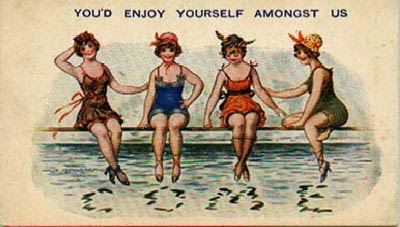
As the Victorian era passed into the Edwardian and Roaring Twenties, a market developed for bisque and china bawdy novelties and figurines of women in revealing outfits. Although now most of these figurines seem more coy and cute than ribald and risque, in their time they symbolized the casting off of the perceived restraints of the Victorian era.

These little lovelies included bathing beauties, who came clad in swimsuits of real lace or in stylish painted beach wear, as well as mermaids, harem ladies, and nudies, who were meant to wear nothing more than an engaging smile. Also produced were flippers, innocent appearing figurines who reveal a bawdy secret when flipped over, and squirters, figurines that were meant to squirt water out of an appropriate orifice.

Most were manufactured in Germany from the late 1800s through the 1930s, often showing remarkable artistry and imagination, with Japan entering the market during World War I.

Showing posts with label vienna. Show all posts

Thursday, April 27, 2023

Age of Bronze, Finale

This bronze bathing beauty is the last, but not least, of the trio of cast coquettes from the previous postings. She is clad in a bathing outfit consisting short-sleeved nifty nautical blouse and swim shorts to her mid-thigh. Ballet-style bathing slippers adorn her slender ankles and feet. Resting by her knees is wide-brim sun hat nearly identical that lying by the side of the statuesque siren from the previous posting, so they are almost certainly from the same foundry. Her smooth skin has a golden patina, while the bow in her chignon and sun hat are pale red, the blouse silvery, and shorts and shoes have a soft greenish patina. Just 3.5 inches long, she is delicately modeled with fine details. Like the prior bronze beauties, she is unmarked, but mostly likely was made in Austria around the early 1900s.


Friday, March 31, 2023

Age of Bronze II

Another bronze bathing beauty, a bigger sister to the metal miss in the last posting. Reclining in a form-fitting tank swimsuit that clings to very ample curve, this beach belle is 4.5 inches long and 1.5 inches high. Her skin has a golden patina (no doubt from all that seaside sunbathing), with a very pale green patina to her swimsuit and touches of red on bow in her hair and the sun hat lying next to her. The sculpting and casting are excellent, with even tiny details like the waves in her luxurious hair and the texture of her knit bathing suit captured in bronze. Like the prior bronze beauty, she is unmarked, but mostly likely was made in Austria around the early 1900s.

Friday, March 17, 2023

Age of Bronze

This lissome miss is cast in bronze. Although only 2.5 inches tall and high, she is superbly sculpted, from the waves in her thick tresses to the tiny bows on the toes of her ballet-style bathing slippers. Her skin has a soft glowing golden patina, while the nautical blouse of her bathing suit is subtly silvered and her skirt and shoes have a greenish patina. A touch of red tints the bows in her hair and around her slender ankles. Although unmarked, this bronze beach belle is most likely Austrian. Beginning in the mid-19th century, Vienna became the center of many foundries and ateliers producing a wide array of finely crafted artistic bronzes to adorn the homes of those wishing to subtly display their taste and wealth. Although pretty and petite, she is surprisingly heavy for her small size and perhaps could have served as a paperweight for a gentleman's desk. 


Thursday, July 28, 2022

Getting Bronzed

This languorous lass appears to be working on her tan, but she is already a beautiful golden bronze. Just 5 inches long, this sensual sculpture is exceptionally heavy for her size, making her a pulchritudinous paperweight for some gentleman's desk. She has a gilt patina, except for her bathing cap, which has a reddish tint. The sculpting is superb, from her supple curves to her bathing suit with its natty nautical collar to the ribbons on her ballet-style bathing slippers. 


Under her left hip is the "B" within an urn mark of the Viennese foundry of Franz Xaver Bergmann and "Austria."


Thursday, December 17, 2020

Wanna See My . . .Lady?

A number of posts on this blog have featured female figures with strategically placed kitty-cats, a double-entendre of "pussy" as an affectionate name for a cat and as a vulgar reference to female genitalia. The Barrison Sisters built an entire vaudeville career in the 1890s by showing off their "pussies" on stage. This bawdy bronze is a slightly different play on pussy. A cute kitten sits on a marble base. Its realistic fluffy coat and appealing face are superbly sculpted, highlighted with a deep golden patina. Just 5 inches high, but with substantial heft, it could have served as a paperweight for a gentleman's desk.


Why a gentleman? Well, this prurient pussy swings open to expose a kneeling nude lady, smugly smiling as she clutches a cache of jewels. She has a subtler golden patina than her feline friend, and her hair and gems are a softly-tinted rose.


Almost obscured by the curls in the fur, "AUSTRIA" is stamped on the back rim of the cat. Beginning in the mid-19th century, Austria, particularly in Vienna, was famous for its foundries and ateliers producing finely crafted artistic bronzes. The works covered a wide variety of genres, including classical studies, animals and nature, comic subjects, Orientalist images, and even erotic images. Often the naughty bits were concealed in a seemingly innocuous subject, only to be revealed by a push of a button or lifting a up a piece of metal drapery. There is a wide variety of these Austria sculptures  concealing salacious secrets, with nubile nudes hidden within an assortment of owls, mice, sphinxes, mummy cases, Eastern idols, and, perhaps most appropriately, an iron maiden.


Thursday, November 15, 2018

"Mirror, mirror, in my hand. . . ."

. . . .who is the fairest in the land?"  As posted previously on this blog, there was a fad for artistic smoking paraphernalia in the early 1900s, especially ashtrays of bronze and stone.  This kneeling miss admiring both herself and her necklace in her hand mirror is yet another example.  Although this sculpture is signed only "Austria"on the back of the cushion, I attribute this bronze belle to Bruno Zach (1891–1945), a Ukrainian artist who studied sculpture in Vienna and became renown for his bronze sculptures, many of an erotic nature. The woman's extreme oval, almost egg-shaped, head with delicate sharp features and brushed-back hair is very typical of Zach's early ladies. The use of colored patina, such as the silvering on her stockings and the rose tint on her beads, is also found on many Zach pieces.  Beginning in the mid-19th century, Vienna was the home of many foundries and ateliers producing finely crafted bronzes to adorn the homes and offices of those wishing to subtly display their taste and wealth.  She is 4 inches high and her ashtray base of onyx is 7 inches long.


This close up shows the wonderful details of this diminutive sculpture and the subtle use of patina.


Thursday, January 25, 2018

A Chryselephantine Coquette

Chryselephantine in ancient times meant a statue of wood, with a thin veneer of ivory representing skin and gold leaf picking out other details, such as clothing. The term is also used to describe statuettes produced during the art nouveau and art deco periods with parts of finely carved ivory inset into bronze or other materials.  This voluptuous bathing beauty is by Peter Tereszczuk, renown for his cryselephantine creations.  Born in the Ukraine in 1875, Tereszczuk studied sculpting in Vienna, Austria.  Most of his statuettes, representing everything from the innocence of childhood to erotica, were produced in Vienna from the 1890s through the 1920s.  This 6.5 inch tall belle (including her marble base) is garbed in a bronze bathing outfit from the early 1900s, but her bust and arms are of ivory.  From the front, she presents the viewer with a bit more leg than would be proper at the seaside as she nonchalantly adjusts one of her garters.  


However, a view of the back reveals that this little seaside siren needs to adjust more than her garter, as a naughty zephyr has blown up the skirt of her bathing outfit, exposing her bare bottom of subtly sculpted ivory.  


A close up of her serene exquisite face and slender graceful arms displays the superb carving of the ivory.  


The left side of the bronze base is  marked  with the intertwined "T" and "U" of the Tereszczuk-Ullmann foundry and "P. Tereszczuk."


The back of the base is incised "Made in Austria."