Postcard Image

Postcard Image
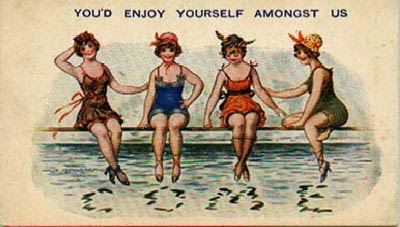
As the Victorian era passed into the Edwardian and Roaring Twenties, a market developed for bisque and china bawdy novelties and figurines of women in revealing outfits. Although now most of these figurines seem more coy and cute than ribald and risque, in their time they symbolized the casting off of the perceived restraints of the Victorian era.

These little lovelies included bathing beauties, who came clad in swimsuits of real lace or in stylish painted beach wear, as well as mermaids, harem ladies, and nudies, who were meant to wear nothing more than an engaging smile. Also produced were flippers, innocent appearing figurines who reveal a bawdy secret when flipped over, and squirters, figurines that were meant to squirt water out of an appropriate orifice.

Most were manufactured in Germany from the late 1800s through the 1930s, often showing remarkable artistry and imagination, with Japan entering the market during World War I.

Showing posts with label German. Show all posts

Thursday, June 30, 2022

Hamming it Up

This shapely sow spreads her swirling skirt, forming a small shallow dish for holding pins or trinkets. Her sly smile suggests that she has a secret.


Turn her over and she reveals two plump pink hams on the hoof. Of colorful glazed china, Ms. Piggie is three inches high and 4.5 inches wide.  The piece is incised "3812" on left edge of the skirt and marked "Germany" in black cursive on the back edge.  It is a rare raunchy example of the once popular pink pig fairings. Fairings were small inexpensive porcelain pieces, often featuring comical or satirical themes, typically given as prizes at fairs or sold as souvenirs from the mid-1800s through the early 1900s. Fairings were made in Germany by a number of companies. In Germany, the pig is a sign of good luck and prosperity. A person who is lucky will say "Ich habe schwein gehabt" (I have had pig). Postcards and other empherma of the period featured glücksschweinchen (good luck pigs), often carrying a four leaf clover or leaping through a horseshoe. There is an entire genre of bisque and china fairings featuring pink pigs engaged in a wide variety of human activities. 


This glamorous gilt has the caption "Newport, RI" in faded gold cursive letters adorning the center of her skirt. Newport since the 1840s has been a resort for the wealthy and in 1875 was described as "the fashionable queen of all American watering resorts, for summer pleasure." It was not only the privileged who flocked to Newport to enjoy its beaches and mild summers, as it also became a destination for the middle and working class. This saucy sow was no doubt purchased as a souvenir of a summer excursion to the popular resort town.


Friday, January 29, 2021

Undine in Orange

This marvelous mermaid must be part goldfish, as her lower body is clad in deep orange scales. Of excellent bisque, this sinuous sea siren is 4 inches long. By the German firm of Willian Goebel, she is stamped underneath "Bavaria" in black and incised with the William Goebel crown, as well as "NG 16."


Goebel produced these finned femme fatales in a variety of eye-catching colors. Here she poses with the same model, pictured in my second book, who is gorgeous in green. They both have the same marks and the vivid coloring of their scales and tails was applied with an airbrush.


Thursday, November 24, 2016

It's a Stretch

This sleepy sultana, luxuriating a sensual stretch, represents how many Americans will no doubt feel after stuffing themselves with turkey and stuffing (although, admittedly most Americans would probably not look quite as fetching in a barely-there jeweled bra and sheer skirt). By the German firm of Galluba and Hofmann, she is a variation of a mold used by the company for a bathing beauty.  Decorated in creams and browns to resemble an ivory carving, this undulating odalisque is 8 inches long.  Of excellent bisque, this luscious lady is incised underneath “9724.”


A case up of her face and upper torso.  Her gold and bejeweled top is not merely painted on, but molded as a series of raised dots.