Postcard Image

Postcard Image
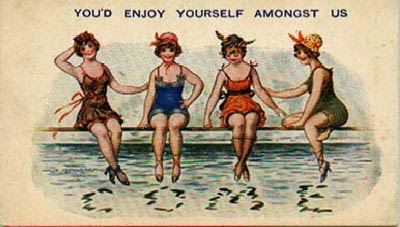
As the Victorian era passed into the Edwardian and Roaring Twenties, a market developed for bisque and china bawdy novelties and figurines of women in revealing outfits. Although now most of these figurines seem more coy and cute than ribald and risque, in their time they symbolized the casting off of the perceived restraints of the Victorian era.

These little lovelies included bathing beauties, who came clad in swimsuits of real lace or in stylish painted beach wear, as well as mermaids, harem ladies, and nudies, who were meant to wear nothing more than an engaging smile. Also produced were flippers, innocent appearing figurines who reveal a bawdy secret when flipped over, and squirters, figurines that were meant to squirt water out of an appropriate orifice.

Most were manufactured in Germany from the late 1800s through the 1930s, often showing remarkable artistry and imagination, with Japan entering the market during World War I.

Showing posts with label William Goebel. Show all posts

Thursday, December 21, 2023

Gorgeous Goebel

This large and lovely bathing beauty is an unusual example from the German firm of William Goebel. Her excellent china was made with precolored pink slip and her orange-red tank suit is cold-painted. 


Her exquisite face is framed by her glossy black bobbed hair and her slender hands gesture gracefully.


Underneath she is incised with Goebel's crowned intertwined "G" and "W," as well as "F.N. 757." This use of capital letters is also typical of Goebel. This big beautiful bathing belle is 6.5 inches long and 3 inches high.


Saturday, August 14, 2021

Shell Game

Any collector would be a winner with this shell-decorated box topped by two nubile bisque nudes. Although it has become common to refer to any antique shell-adorned box as a "sailor's valentine," the term should properly apply to the intricate and colorful shell creations housed in hinged boxes and produced in Barbados to sell to sailors during the 1800s. However, during the Victorian period it was fashionable for ladies of leisure to engage in shell craft, adorning boxes and other items with tiny shells painstakingly dipped in wax or glue and arranged in elaborate designs. The hobby was so popular that it was possible to purchase patterns and packets of presorted shells. An offshoot of the craze for shell-bedecked knick-knacks was a cottage industry in creating shell-encrusted souvenirs to be peddled at popular tourist resorts along the coasts of England and France. Wood boxes covered in paper, often in whimsical shapes, were decorated with sea shells, typically locally collected. While the sea shells were not as colorful and the patterns not as intricate as those produced in Barbados or Victorian parlors, the boxes were unusual and inexpensive souvenirs of a sea-side sojourn. Often a bisque figurine, a chromolithographed scrap, or other item was included to add color and interest. The two bare bisque bathing belles on this box certainly add both!


Both beauties are each around 4 inches long. It is not possible without detaching them to look for marks, but they appear to be part of a series by William Goebel of lovely ladies clad only in a ribbon tied around their high-piled tresses. 


The box itself is about 8.25 inches long and 4 inches high, not including the sizable shells covering the lid. It is made of thin wood covered in red paper. The interior is lined in faded red fabric and features a mirror edged in red cord. 


Thursday, May 20, 2021

The Lady in Red

Oh! the lady in red, the fellows are crazy 
For the lady in red
She's a bit gaudy, but laudy 
What a personality.

1935, lyrics by Mort Dixon, music by Allie Wrubel

Most collectors, fellows or not, would be crazy for this lady in red in her saucy scarlet swimwear.  Of excellent china and 5 inches tall, she sits insouciantly in a molded wicker beach chair. 


This rubious beauty is actually a utilitarian powder or trinket box. Underneath, her seat is incised "D.F. 216," as well as with the William Goebel intertwined "G" and "W" under crown and "Dep." The Goebel mark is also stamped in blue.


Friday, January 29, 2021

Undine in Orange

This marvelous mermaid must be part goldfish, as her lower body is clad in deep orange scales. Of excellent bisque, this sinuous sea siren is 4 inches long. By the German firm of Willian Goebel, she is stamped underneath "Bavaria" in black and incised with the William Goebel crown, as well as "NG 16."


Goebel produced these finned femme fatales in a variety of eye-catching colors. Here she poses with the same model, pictured in my second book, who is gorgeous in green. They both have the same marks and the vivid coloring of their scales and tails was applied with an airbrush.


Thursday, October 22, 2020

Another Tiny Treasure from William Goebel

This china cutie in a canoe is another diminutive bathing belle by William Goebel, the shallow boat-shaped bowl suitable for holding rings or small trinkets.  Goebel created a series of these Lilliputian lasses, either adorning utilitarian trinket dishes or pincushion tops or simply as itty-bitty bathing beauties. The miniature maiden is a mere 1.5 inches tall and the dish is 4.5 inches long. 

Goebel may have liked small bathers, but it was big on markings. Underneath the dish carries the Goebel crowned "G" and "W," both incised and in blue.  It is further incised "RF 666" (this dainty dish, posted previously on this blog, also has a 600 number) and "Dep," as well as being stamped in black "Germany." There is also a red freehand "W."  


Thursday, October 8, 2020

This Goebel Girl Gets Around. . . .

Perched on the edge of a black and white checkerboard dish for rings or trinkets, this tiny china bathing belle is by William Goebel. Goebel used the mold for this little gal to create a variety of goods, as she  has been featured on this blog before, both as a pincushion  and as a stand- (or I guess in this case, -sit) alone figurine. The entire piece is only 2.75 inches wide.


There is no doubt regarding the maker, as the underside is amply marked. There is Goebel's crowned intertwined "G" and "W" mark, both incised and stamped in blue. Other marks include an incised "Dep," "Germany" stamped in black, a black freehand "k," and an incised "RF" followed by a 600 number partially obscured by a paper label for Herpolsheimer Co. (which reveals that this diminutive dish sold originally for 75 cents). In 1870, William G. Herpolsheimer and C.G.A. Voight opened a small dry goods store in Grand Rapids, Michigan. By 1901, the store operated under the name of the Herpolsheimer Company, eventually developing into a large department store with branches in Michigan and Wyoming. The downtown store in Grand Rapids was remodeled in 1949 and hailed for its modern design, which featured a three-story display window over the main entrance. It was a landmark in the city for decades, but in 1986, over the protests of preservationists, it was gutted and altered to create a shopping mall. In the 1990s, the company was acquired by the Lazarus store chain.      


Thursday, April 25, 2019

Go Fish!

Anne Harriet Fish (1890-1964), although born in Britain became a renown artist, illustrator, and cartoonist on both sides of the "pond." Her work appeared in Condé Nast's Vanity Fair, Vogue, and Tatler. Fish also created designs for Fulper Pottery of Flemington, New Jersey, and Hubley Manufacturing Company, which made cast iron toys and novelties, such as doorstops.  This lamp base is an Anne Fish design for Fulper.  It features two very stylized flapper bathing belles sitting back to back.  These colorful cuties are 6.25 inches high.


The egg-shaped heads, heart-shaped lips, and large half-circle eyes with long lower lashes are typical of Fish's frolicsome females.


Her signature appears by the hole that would have held the lamp stem.  She signed her drawings and illustrations with only her last name.


The oval ink mark dates this piece between 1917 to 1934.


Fish's illustrations for Vanity Fair, first published in 1913, captured the essence of the new woman, youthful, slender, and always ready for a little flirtation or fun. Over a roughly 15-year period, Fish created some 30 covers for the magazine, as well as many inside illustrations.  Two covers in particular portray similar dual bathing belles. This one dates from February 1916.


Fish returned to the theme with this June 1923 cover. Condé Nast has an online store where you can view a collection of Fish covers, as well as order a print of your favorite.


This pair of bathers perching on a perfume bottle appeared earlier on this blog.  The bottle is stamped underneath “Bavaria” and is incised “X.F. 269,” “Dep,” and with the William Goebel crown mark.  It is clear that this Goebel piece was inspired by the work of this popular illustrator of the period.


Thursday, April 5, 2018

Itty Bitty Bathing Beauties


A mere 1.75 inches high, including her base, this tiny china bathing beauty is surprisingly detailed and delicately decorated.  Her unusual base has a channel around rim with sew hole on each side.  Although marked only with a freehand "g" in black inside the base, she can be definitely attributed to the German firm of William Goebel.


One reason I can be so certain of my attribution is this quartet of diminutive damsels who have been featured earlier on this blog.  Although only 2.5 inches high, the figurine of the beach belle in the hooded “wicker" beach chair is incised underneath with the Goebel crowned intertwined “G” and “W” and what appears to be “P.O.” over “641.”  This is the only piece of the quartet that is marked.  She strikes a similar pose as that of the petite pincushion miss, with her hands tucked under her knees and her legs crossed at the ankle, though hers are left over right.  However the 1.25-inch long and high seated bathing beauty in red, who is clearly part of this series, is the identical model as that used on the pincushion base.  The reclining lady in red is 2.5 inches long and the decorator has added dots of blush to her knees.  The gal in green is a mere 2 inches long.  All these tiny treasures beautifully modeled and decorated considering their amazingly small size.  


Thursday, April 13, 2017

Ravishing Redhead

As in the real world, true red-headed bathing beauties are uncommon, especially when they are as stunning as this copper-tressed cutie.  Of excellent flawless bisque, this femme with flame-colored locks is 4.5 inches tall and 4 inches wide.  Beautifully modeled from her slender curves to her lithe limbs, she is faintly stamped “Bavaria” in black under her right thigh, a mark typical of the German firm of William Goebel, and is incised under her hips “801 C2.”  


A close up of this gorgeous ginger gal's lovely face with unusual amber-colored eyes.


Thursday, January 19, 2017

Pretty in Pink

Although only 2.25 inches tall, this china full-figure bathing beauty pincushion doll displays amazing detail, from her delicately painted features to the fact that her graceful arms and shapely legs are free from her body. There are no marks, but William Goebel did use this type of unusual domed base for some of its pincushion ladies.


Thursday, January 5, 2017

Just Hanging Around

This very unusual mermaid by William Goebel is made to adorn the edge of an aquarium.  Of excellent bisque, this sultry sea siren is 4.5 inches long.    


Her folded arms are angled away from her body, forming a little ledge to fit over the lip of a fish tank.       This perch is rather perilous, as a little bump can easily dislodge her, sending this fragile finned femme crashing to the floor.  I suspect not too many of these nubile naiads survived.


She is stamped “Bavaria” in black on her left hip, a mark often used by Goebel.